
Asset Forfeiture Bill Must Firmly Pursue Criminal Proceeds Whilst Protecting Citizens' Rights
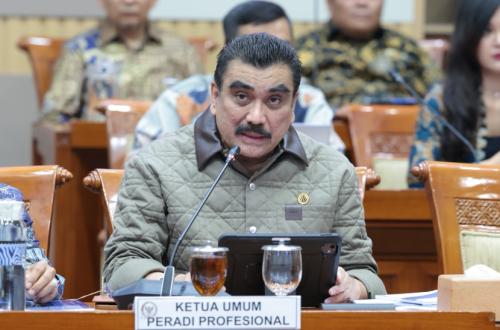
REPUBLIKA.CO.ID, JAKARTA – Deliberations on the Asset Forfeiture Bill face the challenge of strengthening the state’s authority to pursue the proceeds of crime without opening the way for the seizure of lawfully acquired property. A range of views on the limits of authority, evidentiary mechanisms and the protection of citizens’ rights were presented at a public hearing of Commission III of the Indonesian House of Representatives on Monday (7/9/2026).
At the hearing, Peradi Profesional expressed support for the state’s efforts to eradicate criminal acts and recover the proceeds of crime. However, that objective was deemed to need to proceed in line with the principles of the rule of law, legal certainty, protection of human rights and due process of law.
Peradi Profesional Chairman Arthur Hedar said the fundamental issue in the Asset Forfeiture Bill is not merely how far the state’s power to seize assets extends, but how to ensure that such authority does not become excessive power that is abused by law enforcement officials.
“The state must be strong in confronting criminals, but the state must also be strong in protecting its people. The zeal to seize the proceeds of crime must not end up opening the door to the seizure of lawfully acquired property,” Arthur said at the hearing, according to a press release.
Peradi Profesional reminded the House of Representatives that the asset forfeiture mechanism, particularly one that does not depend on a criminal conviction against an individual, must have clear limits and robust judicial oversight.
The principle of the presumption of innocence, lawful property rights, the right to a defence, the rights of bona fide third parties, and objection and restitution mechanisms were deemed to need genuine guarantees in the legislation.
The question of the burden of proof has also drawn attention. A person must not automatically be positioned as though guilty simply because they are unable to explain the origins of their wealth.
The state and law enforcement officials still need to have grounds, initial evidence and a legally accountable connection between the assets and the criminal act.
At the hearing, Peradi Profesional also conveyed lessons from a number of major cases, including matters relating to the tin trade. Such cases demonstrate the enormous consequences a legal process can have on the wealth of an individual or third parties.
For that reason, determining whether an asset truly originates from a criminal act cannot, it was argued, be based solely on suspicion or an overly broad approach. The process of proof needs to be carried out objectively and testable before a court.
Peradi Profesional judged that the Asset Forfeiture Bill must not be built on the logic of “seize first, and let the owner subsequently prove their wealth is lawful”. That approach risks undermining the fundamental principles of the rule of law and opening the door to arbitrariness.
Beyond the evidentiary mechanism, Peradi Profesional warned of the possibility of abuse of authority in the future. The law, it was argued, needs to be drafted with mechanisms that prevent such authority from being used for purposes outside law enforcement.
“The Asset Forfeiture Bill must never become, one day, an instrument to suppress political opponents, certain groups, businesspeople or members of the public who have in fact acquired their wealth lawfully. That is why the legal safeguards must be put in place now,” said Prof Harris.
To that end, Peradi Profesional called on the House of Representatives to strengthen mechanisms of checks and balances, judicial oversight, evidentiary standards, protection of bona fide third parties, objection mechanisms and the accountability of officials in cases of abuse of authority.
Indonesia, it was argued, needs an effective Asset Forfeiture Law to pursue and recover the proceeds of crime. However, the effectiveness of such a law will also be determined by its ability to ensure that the forfeiture process does not sacrifice the rights of citizens who have legitimately acquired and own their assets.
“Eradicate the crime, pursue and recover the proceeds of crime, but never sacrifice justice and the rights of the people. The law must remain a protector, not turn into a tool of power,” he said.
Source: jawawa.id (https://jawawa.id/newsitem/asset-forfeiture-bill-must-firmly-pursue-criminal-proceeds-whilst-protecting-citizens-rights-1788782009)
Originally published by Republika (https://news.republika.co.id/berita/tkzp6x416/ruu-perampasan-aset-harus-tegas-kejar-hasil-kejahatan-hak-warga-tetap-dilindungi), translated from Indonesian