
Assessing the Indonesian Stock Market Ahead of MSCI’s November 2026 Review
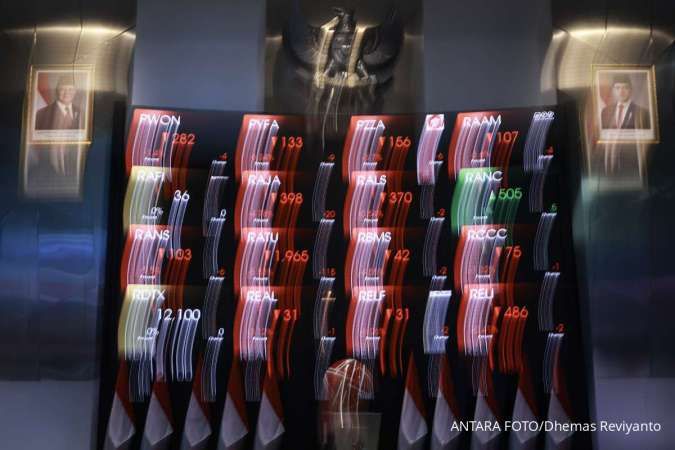
KONTAN.CO.ID – JAKARTA. Pressure on the Jakarta Composite Index (IHSG) following the outcome of MSCI’s November 2026 review could also affect the market capitalisation and valuations of companies listed on the Indonesia Stock Exchange (BEI).
On Friday (30 October 2026), the IHSG closed at 5,057 on the Indonesia Stock Exchange (BEI). The index has fallen 16.23% over the past month.
Since the start of the year, the IHSG has recorded a year-to-date (YTD) decline of 41.25%.
Over the past month, net selling on the regular market reached Rp 18.77 trillion. Foreign investors have also withdrawn Rp 126.20 trillion YTD.
According to BEI data, the exchange’s market capitalisation stood at Rp 8,862 trillion, while the IHSG’s market capitalisation was Rp 2,191 trillion at the end of October 2026.
At the end of October, the market’s price-to-earnings ratio (PER) was 1.76 times and its price-to-book value ratio (PBV) was 1.32 times.
As at September 2026, PT Bank Central Asia Tbk (BBCA) was the company with the largest market capitalisation, at Rp 741.40 trillion, or 6.93% of total market capitalisation.
It was followed by PT DCI Indonesia Tbk (DCII) at Rp 471.98 trillion (4.41%), PT Bank Rakyat Indonesia Tbk (BBRI) at Rp 4,471.13 trillion (4.41%), PT Bayan Resources Tbk (BYAN) at Rp 393.33 trillion (3.63%), and PT Barito Renewables Energy Tbk (BREN) at Rp 387.98 trillion (3.63%).
The BEI had not yet uploaded October 2026 company market-capitalisation data to its official website.
The large outflow of foreign funds suggests that market pressure is not merely a technical correction. It also reflects an investor confidence crisis over transparency, governance and regulatory certainty in Indonesia’s capital market.
“As long as these issues have not been convincingly resolved, investors tend to reduce their exposure to risky Indonesian assets,” he told Kontan on Sunday (1 November 2026).
Technically, the IHSG remains in a bearish trend, with a tendency to weaken towards 4,980. If that level is breached, the index could continue its correction to the next support level, in the 4,907 range.
A fall towards 4,000 cannot be entirely ruled out, but would require a combination of more extreme negative sentiment, such as an unfavourable MSCI decision, even heavier foreign outflows, a weaker rupiah and deteriorating market confidence.
The November MSCI announcement is therefore an important catalyst, but its impact will depend on whether the decision is worse or better than expected.
“If the outcome is more moderate and accompanied by a commitment to improve transparency, the IHSG could see a technical rebound,” he said.
Liza Camelia Suryanata, Head of Research at Kiwoom Sekuritas, said the assumption that the IHSG would fall to 4,000 was too speculative to be used as a forecast without a clear calculation.
She also said it was important to distinguish between MSCI’s November rebalancing and the risk of Indonesia being reclassified as a Standalone Market, a decision due no later than June 2027.
The removal of 81 HSC shares from the IHSG on 2 November would not automatically lower the index, as the BEI adjusts the divisor.
“The main risks to the stock market remain foreign outflows, pressure on the rupiah exchange rate and the failure of institutional investor confidence to recover,” she told Kontan on Friday (30 October 2026).
Hendra said a fall in the IHSG would directly affect companies’ market capitalisation, as a decline in share prices reduces their market value.
Large-cap stocks could lose a significant amount of market value in nominal terms, while companies with the steepest share-price falls would see the sharpest declines in market capitalisation.
Pressure could be concentrated in conglomerate, energy and mining, infrastructure, technology and property stocks, particularly companies with low free floats or under scrutiny over ownership transparency and price formation.
Falling valuations do not always reflect worsening fundamentals; they may also indicate a higher risk discount demanded by investors.
“As long as governance uncertainty remains unresolved, market capitalisation and valuations could remain under pressure,” he said.
In trading on 29 October, the biggest drags on the IHSG were BBCA (-30.5 points), BBRI (-16.2), ASII (-12.6), BMRI (-9.6) and TLKM (-8.3). This means the pressure came mainly from the banking, industrial and telecommunications sectors.
Valuation pressure is not solely the result of weaker fundamentals, but also of a rising risk premium, the rupiah’s exchange rate and foreign selling.
“As long as investor confidence has not recovered, the risk of further market-capitalisation erosion remains,” he said.
Hendra advised investors to distinguish between companies whose shares are under pressure because of market sentiment and those whose business performance is genuinely deteriorating.
Companies with strong cash flows, manageable debt, stable profitability and resilience to an economic slowdown still have a chance of maintaining their performance.
Potential positive drivers include stronger commodity prices, operational efficiency, rising demand and possible dividends.
Conversely, weaker commodity prices, currency pressure, higher funding costs and continued foreign outflows are the main risks.
Liza said investors should not focus too heavily on market rumours and short-term index movements, but should return their attention to company fundamentals.
Many companies, in fact, recorded double-digit profit growth in the third quarter of 2026. These included BMRI, with profit up 20.7% year on year; ANTM, up 47.9%; ISAT, up 37.2% year on year; MAPI, up 25.1% year on year; and AKRA, up 34% year on year.
This means share-price pressure does not always reflect weakening business performance. Selective accumulation opportunities remain in companies with strong fundamentals, attractive valuations and adequate liquidity.
“Market sentiment can change quickly, but the quality of fundamentals will determine investment value in the long term,” she said.
Hendra said that, amid continued market instability, commodity-based stocks with sound fundamentals and relatively strong cash-flow potential remained worth watching.
He gave speculative buy recommendations for PTBA, ADRO and MEDC, with target prices of Rp 3,500, Rp 2,600 and Rp 1,550 per share, respectively.
Source: jawawa.id (https://jawawa.id/newsitem/assessing-the-indonesian-stock-market-ahead-of-mscis-november-2026-review-1793548227)
Originally published by investasi.kontan.co.id (https://investasi.kontan.co.id/news/menilik-nasib-pasar-saham-indonesia-jelang-review-msci-november-2026), translated from Indonesian