
Asia’s Currencies Under Fire: Peso, Ringgit and Rupiah Hit by the Strong Dollar
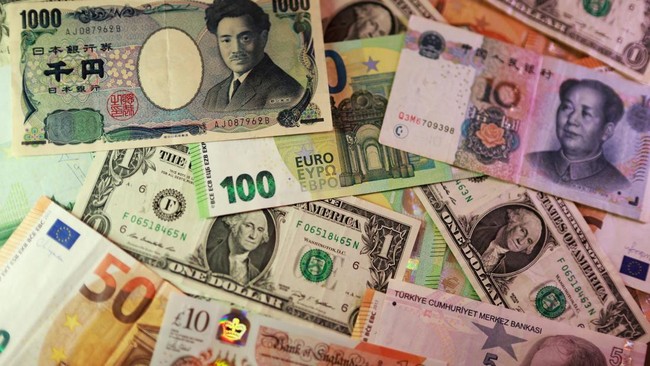
Jakarta, CNBC Indonesia — Asian currencies were battered this week, including the rupiah.
The rupiah ended trading 0.19% stronger against the US dollar on Friday (13 November 2026), at Rp 18,190 per US$1. The gain broke a losing streak after the currency fell on Wednesday and Thursday.
On Thursday, the rupiah hit a record low of Rp 18,255 per US$1. It also plunged 0.61% over the week.
Pressure on the rupiah this week came from both external and domestic factors. A surge in the dollar index weighed on the currency, with the index climbing to 103.4, its highest level since the start of the trade war in April 2025.
Domestically, pressure came from political turmoil after Gibran Rakabuming Raka submitted his resignation as vice-president on Thursday.
Irman Faiz, lead economist at Bank Danamon Indonesia, said global and domestic pressures could increase Indonesia’s risk premium. Political uncertainty may lead investors to demand higher returns to invest in domestic assets.
“Our risk premium is rising because of uncertainty over the continuation of political stability. However, we believe the impact is relatively limited because what matters most to investors is continuity in commitments and policies,” Irman told CNBC Indonesia on Thursday (12 November 2026).
He said the market impact would depend on how smoothly the political process proceeded and whether government policies continued. Risks could increase if the uncertainty spread to relations between political parties or to social stability.
In response to the pressure, Bank Indonesia (BI) said it would continue to maintain rupiah stability. Erwin Gunawan Hutapea, head of BI’s Monetary and Securities Asset Management Department, said the rupiah’s movements remained in line with regional currencies, with a monthly decline of 0.11%.
“In general, the rupiah’s movements remain in line with those of regional currencies. Bank Indonesia continues to be present in the market to maintain rupiah exchange-rate stability in line with its fundamentals,” Erwin said in a written statement on Thursday (12 November 2026).
Stabilisation measures include Non-Deliverable Forward (NDF) transactions in offshore markets, as well as Domestic Non-Deliverable Forward (DNDF) and spot transactions in the domestic market. BI is also buying government bonds (SBN) on the secondary market to help maintain financial-market stability.
The rupiah was not alone
The weakening of Asian currencies was not limited to the rupiah. The Philippine peso was the region’s worst-performing currency this week, plunging 1.16%, followed by the Thai baht, which fell 0.86%.
Heavy selling amid worsening economic conditions dragged down the peso.
Luis Limlingan, head of sales at Regina Capital Development Corporation, said investors remained cautious as persistent macroeconomic pressures continued to curb risk appetite in financial markets.
Yen sinks again, nearing 160 to the US dollar
The Japanese yen slumped again, nearing JPY 160 to the US dollar for the first time in about two and a half months. This came despite the Japanese government spending more than JPY 15 trillion to support the currency at the end of July and intervening in the market alongside the United States for the first time in 28 years.
The main trigger for the latest fall was increased speculation that US interest rates would rise. US consumer inflation, measured by the Consumer Price Index (CPI), came in above market expectations in October, according to figures released on 10 November. This fuelled expectations that the US Federal Reserve (the Fed) would raise its benchmark rate next month.
Some market participants even expect the Fed could raise rates by 50 basis points, double the usual 25-basis-point increase.
These expectations have further strengthened the US dollar. A US rate rise would widen the yield gap with Japan, prompting investors to sell low-yielding yen and switch to the dollar.
Meanwhile, cautious policy signals from the Bank of Japan (BOJ) have also weighed on the yen.
BOJ Policy Board member Toichiro Asada said in a lecture in Nagasaki on 12 November that any rate rises should be implemented very carefully, particularly in terms of their pace.
He also said the impact of rate rises on the real economy was now greater than before.
Asada, appointed by Sanae Takaichi’s government, is known as a supporter of loose monetary policy and is generally cautious about raising interest rates.
The BOJ raised its benchmark rate to 1.25% in September and held it steady in October. Although the central bank has signalled that it will continue raising rates, the slow pace of monetary tightening risks keeping the yen under pressure if the Fed moves more aggressively.
Japan signals possible fresh intervention
The Japanese government has again begun signalling that it could intervene in foreign-exchange markets to stem the yen’s decline.
Atsushi Miura, an official at Japan’s Ministry of Finance, said recent exchange-rate movements had been too rapid.
“I strongly feel that recent exchange-rate movements have been too fast. Have we already forgotten what happened last summer?” he told reporters on 12 November.
His remarks referred to the Japanese government’s large-scale intervention last summer to curb speculation against the yen.
At the end of July, when the yen was nearing JPY 164 to the US dollar — its weakest level in almost 40 years — the Japanese government carried out the largest market intervention in its history.
Source: jawawa.id (https://jawawa.id/newsitem/asias-currencies-under-fire-peso-ringgit-and-rupiah-hit-by-the-strong-dollar-1794624641)
Originally published by CNBC Indonesia (https://www.cnbcindonesia.com/research/20261114085520-128-785201/asia-kebakaran-hebat-peso-ringgit-rupiah-jadi-korban-ganasnya-dolar), translated from Indonesian