
Asian Markets Weighed Down by Technology Stocks; South Korea’s Kospi Plunges 4.49%
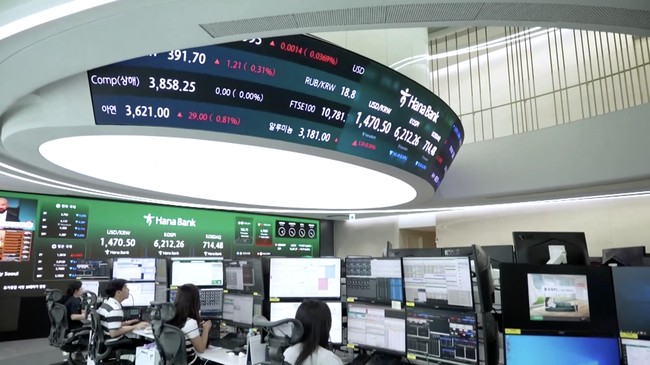
Asian stock markets fell on Wednesday (25 November 2026), following pressure on Wall Street in the previous session.
According to CNBC, South Korea’s Kospi plunged 4.49%, while Japan’s Nikkei 225 fell 1.41%. Australia’s S&P/ASX 200 also slipped 0.41%.
The declines came amid mounting pressure on technology stocks, particularly after several artificial intelligence (AI) companies suffered steep losses.
One company in focus was Ambarella, whose shares plunged 37% in extended trading in the United States. The fall followed the low-power AI vision and video chip designer’s announcement that it expected fourth-quarter revenue of US$70 million to US$75 million.
That forecast was well below the US$112 million expected by analysts surveyed by LSEG. The substantial gap between the company’s guidance and the market estimate put pressure on Ambarella shares.
On Wall Street, the S&P 500 and Nasdaq Composite closed lower as technology stocks gave back some of their gains from the previous session. The S&P 500 fell 0.5%, while the Nasdaq Composite dropped 1.5%.
The two indices came under pressure as Nvidia shares fell and Anthropic slipped below its initial public offering (IPO) price. By contrast, the Dow Jones Industrial Average, made up of 30 stocks and less exposed to the technology sector, rose by more than 400 points, or 0.9%.
The volatile market moves formed part of the turbulence that has marked trading this month. Even before reports about Jensen Huang’s removal and return as Nvidia’s leader, and the Democratic Party’s victory in the US midterm elections, investors had been weighing the outlook for AI development amid a deteriorating macroeconomic outlook.
Liz Ann Sonders, chief investment strategist at the Schwab Center for Financial Research, said selling across the AI ecosystem had begun before the reports concerning Huang and Nvidia emerged. She made the comments to CNBC’s Closing Bell programme on Tuesday.
Investor concerns, she said, relate to capital expenditure (capex), data-centre construction, and the gap between the cost of capital and the return on invested capital. The market is also beginning to distinguish between sectors that are generating profits and those that are still losing money.
Sonders said these issues reflect the broader state of the market. Pressure on technology and AI stocks is therefore not driven solely by recent developments at Nvidia, but also by investors’ assessments of companies’ profit prospects and investment needs.
Market participants will next focus on the release of the US personal consumption expenditures (PCE) price index for October, scheduled for Wednesday morning local time. The indicator is closely watched because it is one of the inflation measures monitored by the US central bank, the Federal Reserve.
Economists surveyed by Dow Jones expect headline PCE inflation to rise by 0.3% month on month and reach 3.8% year on year. Alongside the inflation figures, investors will also watch US weekly jobless claims, which are being released earlier than usual.
The claims data have been brought forward because US financial markets will be closed on Thursday for the Thanksgiving holiday. Both economic releases could help investors assess the state of the US economy and the likely direction of monetary policy.
Source: jawawa.id (https://jawawa.id/newsitem/asian-markets-weighed-down-by-technology-stocks-south-koreas-kospi-plunges-4-49-1795575055)
Originally published by CNBC Indonesia (https://www.cnbcindonesia.com/market/20261125075143-17-788147/bursa-asia-tertekan-saham-teknologi-kospi-korea-anjlok-449), translated from Indonesian