
Asian Markets Mostly Weaker, Oil Price Breaks US$106 per Barrel
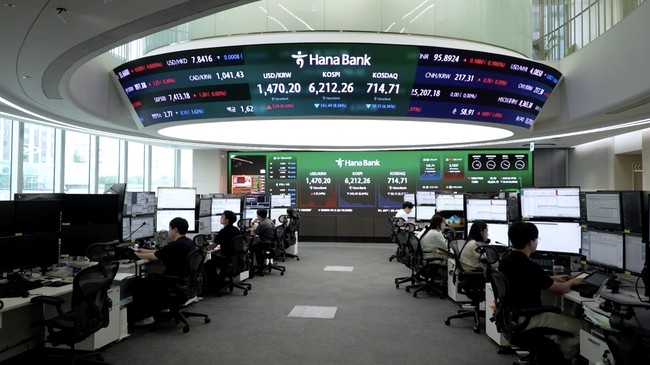
Jakarta, CNBC Indonesia — Asian stock markets moved mostly lower in trading on Tuesday (15/9/2026), amid rising global oil prices that once again sparked concerns over disruptions to global energy supplies.
According to Stock Index data, Australia’s ASX 200 weakened 0.51% to 8,705.2. The FTSE Bursa Malaysia KLCI fell 0.46% to 1,690.18.
The decline also hit New Zealand’s NZX 50 index, which corrected 0.28% to 13,523.4. Meanwhile, Singapore’s STI index slipped 0.27% to 5,702.56.
Taiwan’s Weighted Index fell 0.10% to 45,816.01, whilst South Korea’s KOSPI corrected 0.04% to 6,681.98.
Amid the pressure, Japan’s Nikkei 225 index actually strengthened 0.38% to 63,732.79.
Meanwhile, global crude oil prices continued to strengthen after an attack on Saudi Arabian energy infrastructure disrupted operations of the East-West oil pipeline. This has heightened market concerns over oil supplies amid the ongoing Middle East conflict.
Brent crude rose 1.18% to US$106.93 per barrel. Meanwhile, US West Texas Intermediate (WTI) crude gained 1.24% to US$102.65 per barrel.
The rise in oil prices came after an attack on Friday (11/9/2026) disrupted Saudi Arabia’s East-West pipeline. This pipeline is a key piece of infrastructure enabling Saudi Arabia to divert its oil exports away from the Strait of Hormuz, which has experienced shipping disruptions.
Supply concerns intensified after the Iran-backed Houthi group launched fresh attacks on Saudi Arabia on Monday (14/9/2026). These attacks also raised the risk of the Middle East conflict widening.
Reuters reported that Saudi Arabia’s East-West pipeline had previously been used to divert around 4 million barrels of oil per day to the port of Yanbu on the Red Sea. That figure is equivalent to roughly 4% of global oil supply.
If the disruption persists, global oil supplies could come under further pressure. This has led market players to monitor developments in the pipeline’s operations as well as the smooth flow of shipping through the Strait of Hormuz.
The rise in oil prices could add pressure on stock markets, particularly if it triggers concerns over inflation and energy costs. However, the movement of Asian markets in today’s trading was also influenced by other sentiment, so the rise in oil prices cannot be confirmed as the sole cause of the indices’ weakness.
Source: jawawa.id (https://jawawa.id/newsitem/asian-markets-mostly-weaker-oil-price-breaks-us-106-per-barrel-1789440718)
Originally published by CNBC Indonesia (https://www.cnbcindonesia.com/market/20260915083519-17-767912/bursa-asia-mayoritas-melemah-harga-minyak-tembus-us-106-per-barel), translated from Indonesian