
Asian Markets Fall, Oil Prices Surge Ahead of Fed Decision
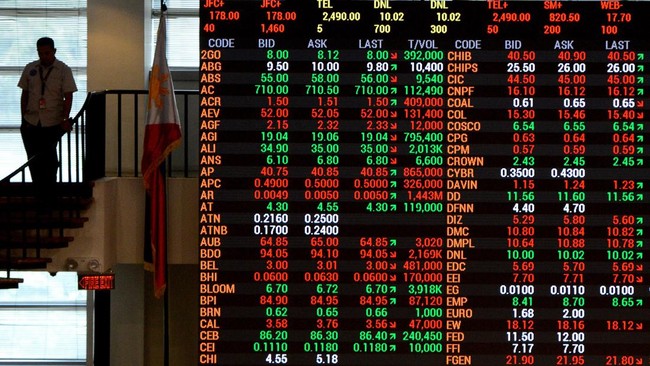
Asian stock markets declined in trading on Monday (14/9/2026), pressured by a new surge in oil prices caused by concerns over global energy supply disruptions. Investors are also bracing for potential interest rate hikes by the central banks of the United States and Japan this week.
Japan’s Nikkei index fell 1.7%, while the South Korean stock index dropped 3.3%. The MSCI Asia-Pacific ex-Japan index also declined by 0.8% in early weekly trading.
Brent crude prices surged by approximately 3% following a series of new attacks against Saudi Arabia and vessels in the Gulf region, heightening fears regarding global energy supplies. Attacks on Saudi oil pipelines and the advances of Houthi groups from Yemen have the potential to exacerbate energy supply disruptions due to conflict.
A meeting between Iran and Gulf Arab nations in Oman, scheduled for Monday to discuss an agreement to reopen the Strait of Hormuz, was also postponed. Threats to shipping lanes in the Strait of Hormuz and Bab el-Mandeb have led analysts to predict that oil prices could remain high for a significant period, potentially driving global inflation.
In the energy market, Brent crude futures last rose 2.6% to US$107.36 per barrel, after surging nearly 9% throughout the previous week. Meanwhile, US West Texas Intermediate (WTI) crude rose 2.4% to US$102.48 per barrel.
Inflation concerns have also intensified after US Consumer Price Index (CPI) reports on Friday showed higher-than-expected price pressures. Markets now see an 86% probability that the Federal Reserve will raise interest rates by 25 basis points on Wednesday and again in December, marking the first increase since mid-2023.
“We now expect the Fed to raise interest rates twice this year, in September and December,” said JPMorgan Chief U.S. Economist Michael Feroli, quoting Reuters on Monday (1s/9/2026).
According to him, the Fed’s failure to follow through on its statements with concrete policy risks undermining the central bank’s credibility. Feroli noted that there are two possibilities: the hike could be a limited adjustment, or the start of a longer rate-hike cycle, depending on subsequent economic data. JPMorgan considers the former scenario more likely, though risks of a sustained tightening cycle remain.
Pressure was also evident in European and US futures markets, with the EUROSTOXX 50 down 0.5%, the DAX weakening 0.4%, and the FTSE correcting 0.1%. On Wall Street, S&P 500 futures fell 0.5%, while Nasdaq futures dropped 1.1%.
US 10-year Treasury yields were slightly lower at 4.97% following significant selling in recent weeks. Throughout last week, 2-year Treasury yields jumped 26 basis points, while 10-year yields rose 19 basis points, causing the yield curve to flatten.
Goldman Sachs Chief U.S. Equity Strategist Ben Snider stated that strong corporate earnings could support Wall Street stock markets even if borrowing costs rise. He noted that while stocks typically face pressure when the Fed begins raising rates, Goldman Sachs still expects a bullish trend in the stock market to continue.
Snider noted that the S&P 500 has historically produced an average negative return of 2% in the first three months of seven rate-hike cycles over recent decades. However, the index has recorded an average positive return of 9% within 12 months following the first rate hike.
In addition to the Fed, markets also anticipate that the Bank of Japan (BOJ) will raise its benchmark interest rate by 22.5 basis points to 1.25% during its meeting on Friday. Markets also expect the BOJ to provide hawkish signals regarding further policy tightening as the central bank seeks to prevent the yen from weakening again, following market interventions that helped keep the currency away from 40-year lows.
In the foreign exchange market, the US dollar stood at 153.49 yen after weakening about 4% over the last two weeks and moving away from its July peak of 163.99 yen. The Euro remained relatively stable at US$1.1592 after finding support at US$1.1570 on Friday.
The British pound moved flat at US$1.3522, while the Bank of England is expected to maintain interest rates at 3.75% on Thursday. The decision could still result in a split vote among policymakers.
In the commodities market, gold prices fell 0.3% to US$4,336 per troy ounce. Rising bond yields have reduced the attractiveness of gold as a non-yielding asset.
Source: jawawa.id (https://jawawa.id/newsitem/asian-markets-fall-oil-prices-surge-ahead-of-fed-decision-1789354416)
Originally published by CNBC Indonesia (https://www.cnbcindonesia.com/market/20260914081259-17-767581/bursa-asia-berguguran-harga-minyak-melonjak-jelang-keputusan-the-fed), translated from Indonesian