
Asian Currencies Won, Yen, Ringgit Under Fire: Rupiah Suffers Most
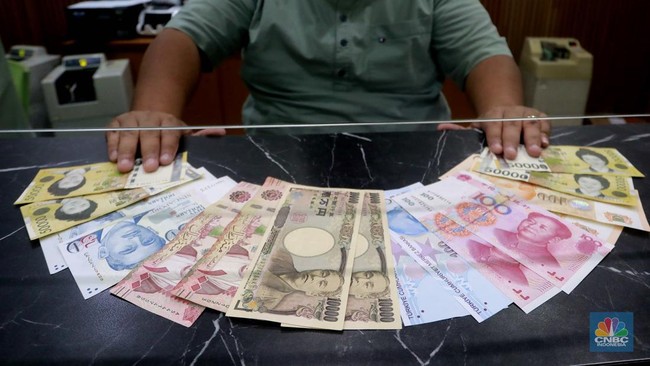
Asian currencies opened trading on Tuesday (28/7/2026) on a sluggish note, with not a single unit able to strengthen against the US dollar amid anticipation of the Federal Reserve’s interest rate decision.
According to Refinitiv data as of 09.15 WIB, all ten Asian currencies were moving in the red against the dollar. The rupiah suffered the deepest pressure in Asia this morning, weakening 0.39% to Rp 18,070 per US dollar, keeping it above the psychological level of Rp 18,000.
Significant pressure was also felt by the South Korean won and the Taiwan dollar, both of which fell 0.29%. The won stood at KRW 1,468.8 per US dollar, whilst the Taiwan dollar was at TWD 32.38. The Thai baht corrected 0.12% to THB 33.65, followed by the Philippine peso which weakened 0.09% to PHP 61.703. The Vietnamese dong fell 0.08% to VND 26,334, whilst the Singapore dollar corrected 0.05% to SGD 1.2919.
Slighter depreciations were seen in the Japanese yen and Malaysian ringgit, both easing 0.02% to JPY 163.78 and MYR 4.084 respectively. The Chinese yuan edged down 0.01% to CNY 6.7667.
Meanwhile, the US dollar index (DXY) was seen weakening slightly by 0.03% to 101.504 at the same time. Despite the minor correction, the DXY remained elevated and near its one-month high. The dollar continued to find support as the market weighed the possibility of a Fed rate hike at this week’s FOMC meeting. The Fed will hold a two-day meeting ending on Wednesday local time, or early Thursday morning Indonesia time.
Market participants noted that a decline in oil prices after the US temporarily halted strikes against Iran had eased some inflation concerns. However, US government bond yields only saw limited declines, keeping the dollar relatively firm. Chris Weston, head of research at Pepperstone, assessed that the dollar’s strength was still underpinned by movements in the US bond market. “The lack of meaningful buying at the front end of the Treasury curve has helped keep the US dollar well supported,” Weston said.
Expectations of a Fed rate hike have not disappeared. Based on the CME FedWatch tool, the market is pricing in a 36.3% chance that the Fed will raise interest rates by 25 basis points at this week’s meeting, up from 16% the previous week. For the September meeting, the market is even pricing in an 81% chance of a rate hike, indicating that participants still see room for further US monetary policy tightening.
Several major brokers are also beginning to see a real risk that the Fed could raise rates this week, driven primarily by the surge in oil prices this month and rising tensions in the Middle East. Mahjabeen Zaman, head of FX research at ANZ Bank, assessed that the dollar could receive a significant boost if the Fed delivers a surprise hike. “If we get a surprise rate hike, that will certainly support the dollar, potentially taking it to new highs and keeping it strong, especially against low-yielding currencies like the Japanese yen and the Swiss franc,” Zaman said.
Investors are also awaiting other key US economic data this week, including second-quarter 2026 GDP growth and the core PCE index, the Fed’s preferred inflation gauge. These figures will provide further clues on the health of the US economy and the future direction of interest rate policy.
Source: jawawa.id (https://jawawa.id/newsitem/asian-currencies-won-yen-ringgit-under-fire-rupiah-suffers-most-1785210672)
Originally published by CNBC Indonesia (https://www.cnbcindonesia.com/research/20260728092433-128-754321/mata-uang-asia-won-yen--ringgit-kebakaran-rupiah-paling-sengsara), translated from Indonesian