
Asian Currencies: Won and Ringgit Rise, but Rupiah Weakens This Morning
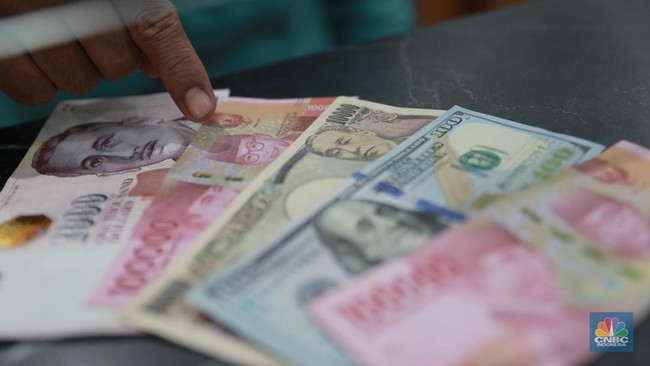
Jakarta, CNBC Indonesia – Asian currencies moved in different directions in early trading on Monday (12 October 2026). Several currencies strengthened as the US dollar edged lower, although the greenback remained close to its highest level in 18 months.
Refinitiv data at 9.26am Western Indonesian Time showed that six of the ten Asian currencies monitored had risen against the US dollar, while three weakened and one was unchanged.
The South Korean won posted the biggest gain of the morning, rising 0.41% to KRW1,334.9 per US dollar.
The Malaysian ringgit followed with a 0.10% rise, while the Singapore dollar gained 0.09%. The Japanese yen and Vietnamese dong rose by 0.08% and 0.07%, respectively, while the Thai baht edged up 0.03%.
The Taiwan dollar, by contrast, came under the heaviest pressure, weakening 0.11%.
The rupiah also failed to join the gains made by most Asian currencies. Indonesia’s currency fell 0.06% to Rp17,885 per US dollar.
The Chinese yuan slipped 0.01%, while the Philippine peso was unchanged.
The US dollar lost a little ground in Asian trading on Monday morning. The US Dollar Index (DXY) was down 0.07% at 102.145.
That decline, however, did little to alter the greenback’s position. The DXY remained near an 18-month high, meaning pressure from the US dollar on global currencies had not fully eased.
The dollar has been supported by tensions in the Middle East and concerns over the direction of energy prices. As the conflict intensifies, investors remain cautious and continue to favour the dollar as a safe-haven asset.
Iran-backed Houthi forces have stepped up attacks on Saudi Arabia, while two oil tankers were also reportedly attacked over the weekend.
Oil prices nevertheless fell in Asian trading. Brent crude was down about 1% at US$103.55 a barrel after US President Donald Trump announced an energy ceasefire between Russia and Ukraine on Sunday.
“We expect the Houthis to continue attacking Saudi Arabian energy assets, which could support higher oil prices and the US dollar,” Commonwealth Bank of Australia analysts wrote, as quoted by Reuters.
The bank also said it did not expect a major breakthrough in US-Iran peace efforts this week, despite Iran confirming that it had received a US peace proposal through an intermediary.
Markets await US inflation data
Alongside geopolitical developments, markets will focus on US inflation data this week.
The US consumer price index (CPI) for September is due on Wednesday. It is one of the last major economic reports before the Federal Reserve holds its policy meeting at the end of October.
The Fed raised interest rates in September for the first time since 2023. Markets are now waiting to see whether inflationary pressures remain strong enough to prompt the US central bank to raise rates again.
According to CME FedWatch, traders currently see an 81% probability that the Fed will keep rates unchanged at this month’s meeting, up from 51% a month ago.
This suggests that markets are increasingly expecting the Fed to pause after last month’s rate rise.
The US dollar could also get some breathing space if this week’s inflation reading comes in below expectations.
Barclays said the dollar’s short-term rally may be nearing a pause. Sharp swings in bond markets in recent weeks have tightened global financial conditions, potentially encouraging Fed officials to adopt a more reassuring tone ahead of the October meeting, particularly if inflation shows signs of easing.