
Asian Currencies Under Severe Pressure: Rupiah Hits New Lows While Yen Remains Stable
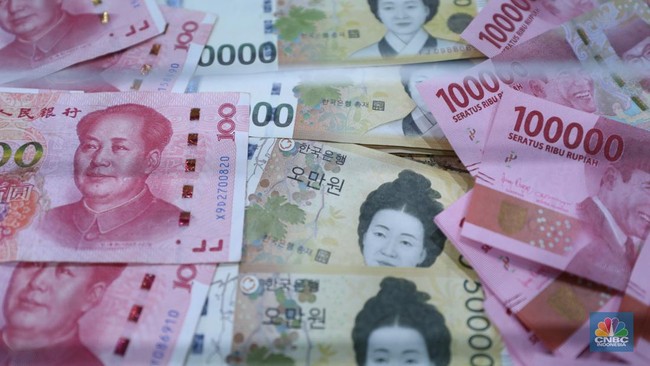
The majority of Asian currencies weakened against the US Dollar during trading on Tuesday (2/6/2026). Pressure resurfaced as the US Dollar Index remained stable to strong amidst increasing demand for safe-haven assets.
According to Refinitiv data as of 09:35 WIB, out of ten monitored Asian currencies, seven experienced depreciation against the US Dollar, two strengthened, and one remained stagnant. The Rupiah was among the most heavily pressured, weakening by 0.39% to a position of Rp17,900/US$. This movement caused the Rupiah to breach psychological levels and hit a new all-time low.
The weakening of the Rupiah aligns with most other Asian currencies. The Malaysian Ringgit weakened by 0.28% to MYR 3.974/US, followedbytheVietnameseDong, whichfell0.25. The Thai Baht also corrected by 0.09% to THB 32.67/US, thePhilippinePesoweakenedby0.08, the Chinese Yuan dropped 0.06% to CNY 6.766/US$, while the South Korean Won weakened slightly by 0.03%.
On the other hand, the Taiwan Dollar managed to strengthen by 0.06%, while the Japanese Yen rose slightly by 0.03% to JPY 159.83/US.Meanwhile, theSingaporeDollarremainedstagnantatSGD1.279/US.
The US Dollar Index (DXY), which measures the strength of the greenback against six major world currencies, was observed to be stable at 99.222. Although movement was limited, the US Dollar remains at a high level due to increased demand for safe havens.
Strengthening sentiment towards the US Dollar occurred after tensions in the Middle East escalated again. The US Central Command reported that Iran launched ballistic missiles towards Gulf nations, although they all failed to hit their targets. The US also reportedly conducted strikes on Qeshm Island in response to attempted attacks from Tehran.
These recent attacks occurred while diplomatic talks between Iran and the United States remain deadlocked. This situation has caused market participants to adopt a cautious stance, keeping the US Dollar in a strong position.
In addition to geopolitical factors, markets are closely monitoring the interest rate policy directions of major central banks. Data on Tuesday showed that Eurozone inflation increased again last month, driven by energy and service prices. This condition strengthens the possibility of the European Central Bank (ECB) raising interest rates this month.
Prolonged conflict in the Middle East and high energy prices are prompting investors to once again factor in the possibility of monetary policy tightening by major central banks this year. This marks a shift from previous market expectations, which had largely anticipated interest rate cuts.