
Asian Currencies Under Pressure: Won and Ringgit Tumble, Only Taiwan Dollar Survives
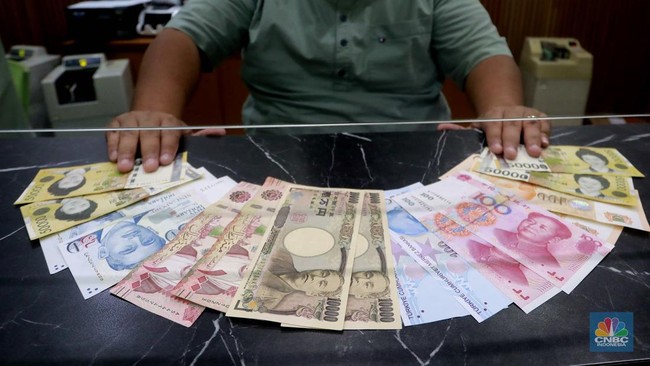
Jakarta, CNBC Indonesia - The majority of Asian currencies weakened against the United States dollar in early trade on Monday (22/6/2026), as the greenback remained firm amid uncertainty surrounding a US-Iran peace deal.
According to Refinitiv data as of 09:15 WIB, only one of the ten monitored Asian currencies managed to strengthen, while the rest suffered declines.
The South Korean won was the worst performer in the region this morning, sliding 0.50% to KRW 1,537.55 per US dollar. The Thai baht also came under significant pressure, weakening 0.30% to THB 32.92 per US dollar. The Malaysian ringgit followed with a 0.24% correction to MYR 4.144 per US dollar, while the Philippine peso fell 0.23% to PHP 60.809 per US dollar.
The rupiah also entered the red zone. The Garuda currency weakened 0.20% to Rp17,810 per US dollar, breaching the Rp17,800 level once again.
Pressure was also felt by the Japanese yen and the Vietnamese dong, both of which weakened 0.17% to JPY 161.56 per US dollar and VND 26,310 per US dollar, respectively. The Singapore dollar corrected 0.13% to SGD 1.291 per US dollar, while the Chinese yuan edged down 0.04% to CNY 6.771 per US dollar.
Amid the broad-based pressure on Asian currencies, the Taiwan dollar was the only one to gain ground, rising 0.20% to TWD 31.612 per US dollar.
Meanwhile, the US dollar index (DXY) was observed to have weakened slightly by 0.01% to 100.844 at the same time. Despite the marginal decline, the DXY remained at an elevated level, meaning the pressure on Asian currencies had yet to subside.
The US dollar maintained its relative strength on Monday as uncertainty once again clouded the interim peace agreement between the US and Iran. Market sentiment deteriorated after US President Donald Trump threatened to reignite war in the Middle East, while Tehran announced the closure of the Strait of Hormuz.
Despite the heightened tensions, peace talks between the US and Iran continued into their second day in Switzerland. The negotiations are taking place under a memorandum of understanding reached the previous week to extend the ceasefire, which has been in place since April, for at least another 60 days.
Chris Weston, head of research at Pepperstone, said it was not surprising that adherence to the agreement was quickly wavering.
“Ultimately, what matters for the market is the flow of cargo through the Strait of Hormuz,” Weston said, as quoted by Reuters.
Shipping data showed the number of vessels passing through the strait dropped sharply on Sunday after Tehran declared it had closed the waterway. This condition helped lift oil prices, with Brent crude rising 1.30% to US$81.62 per barrel.
Weston added that the physical oil market remained tight and could provide support for prices. However, fund flows in the currency and commodity markets, especially gold, would still be heavily influenced by developments in the energy sector.