
Asian Currencies Tumble: Rupiah and Won Slump, Only Peso and Ringgit Stand Firm
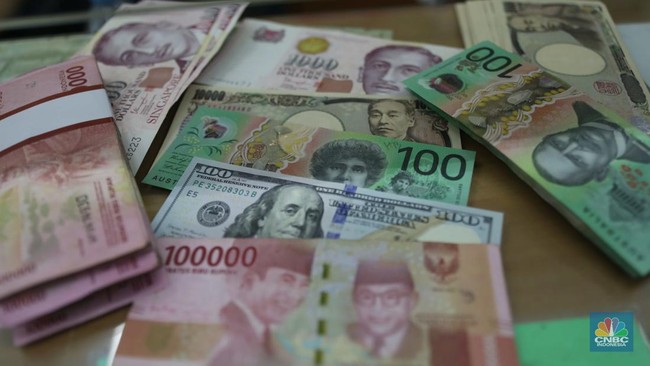
The majority of Asian currencies came under pressure against the United States (US) dollar in trading on Friday, heading into the weekend. The pressure occurred as the US dollar index strengthened again and remained at high levels.
According to Refinitiv data as of 09.15 Western Indonesia Time, out of 10 Asian currencies, seven weakened against the US dollar, two strengthened, and one remained stagnant.
The rupiah was one of the currencies under quite deep pressure in morning trade. The Garuda currency weakened 0.36% to a position of Rp 17,980 per US dollar. This position brings the rupiah ever closer to the psychological level of Rp 18,000 per US dollar.
The deepest pressure this morning was experienced by the Thai baht, which weakened 0.33% to THB 33.43 per US dollar. The South Korean won followed with a depreciation of 0.27% to KRW 1,549.9 per US dollar.
The Taiwan dollar also entered the red zone after falling 0.21% to TWD 31.842 per US dollar. The Singapore dollar weakened 0.10% to SGD 1.296 per US dollar, while the Chinese yuan edged down 0.02% to CNY 6.798 per US dollar.
The Japanese yen also weakened slightly by 0.01% to JPY 161.79 per US dollar. Meanwhile, the Vietnamese dong moved stagnantly at VND 26,314 per US dollar.
On the other hand, the Malaysian ringgit posted the sharpest gain in Asia after rising 0.24% to MYR 4.105 per US dollar. The Philippine peso also managed to strengthen 0.13% to PHP 61.189 per US dollar.
Meanwhile, the US dollar index (DXY) was observed strengthening 0.08% to 101.510 at the same time. This strengthening kept the US dollar in high territory, even though it had corrected slightly in Thursday’s trading, halting a three-day rally.
The DXY had previously moved away from its strongest level since May 2025. However, the US dollar remains on track for a two-week winning streak for the first time since the Middle East conflict erupted in late February.
The recent strengthening of the US dollar has been influenced by expectations of tighter US monetary policy. Following the FOMC meeting last week, the market began to see a divergence in monetary policy direction between the US and other regions, especially Europe.
Analysts at Capital Economics assessed that the US dollar did correct slightly after its sharp post-FOMC rise. However, they see that the divergence in monetary policy direction between the US and Europe could still open room for further strengthening of the greenback in the second half of 2026.
“After the sharp rise following the FOMC meeting last week, the dollar weakened a little today and may pause in the near term,” Capital Economics analysts wrote in their research.
On the data front, US inflation has returned to the market’s focus. The Personal Consumption Expenditures (PCE) price index, the US central bank’s preferred inflation gauge, rose 4.1% year-on-year in May 2026. This increase was in line with economists’ expectations and was influenced by a surge in energy prices due to the Middle East conflict.
Several Fed officials also gave mixed signals. Chicago Fed President Austan Goolsbee noted there was a glimmer of hope from services inflation. However, he still assessed that core price pressures remain too high and are moving in an uncomfortable direction.
Meanwhile, New York Fed President John Williams said inflationary pressures are likely to ease this year. However, the level of inflation is still too high for now.
The comments from Fed officials slightly dampened market expectations for an overly rapid interest rate hike. Based on the CME FedWatch tool, the market is now pricing in a 69% probability that the Fed will hold interest rates steady at the meeting ending 29 July, up from 65.8% the previous day.