
Asian Currencies Surge, While Rupiah Lags Behind
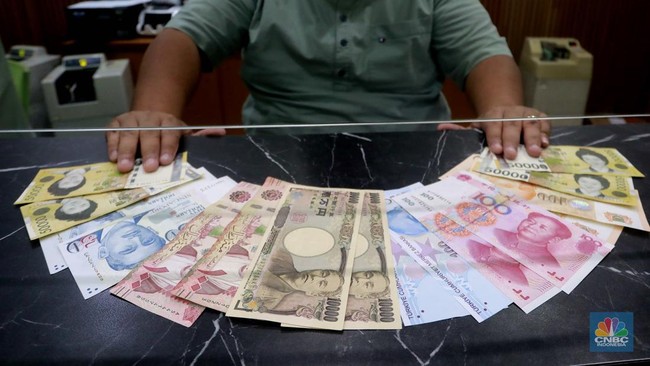
The majority of Asian currencies strengthened against the US Dollar in early trading this week, Monday (2_1/9/2026). However, the Rupiah moved in the opposite direction, becoming the only currency to weaken this morning.
According to Refinitiv data as of 09:33 WIB, nine out of the ten monitored Asian currencies managed to appreciate against the US Dollar, while only the Rupiah entered the red zone.
The Thai Baht and Philippine Peso recorded the sharpest gains in Asia this morning, both rising by 0.09%, with the Baht at THB 33.28/US$ and the Peso at PHP 62.767/US$.
The South Korean Won followed with a 0.06% increase, followed by the Vietnamese Dong at 0.05% and the Taiwan Dollar at 0.04%. The Japanese Yen, Chinese Yuan, and Singapore Dollar all rose by 0.03%, while the Malaysian Ringgit saw a slight increase of 0.02%.
Conversely, the Rupiah was the only Asian currency to weaken, with the ‘Garuda’ currency correcting by 0.28% to a position of Rp17,780/US$.
The US Dollar remains the primary factor influencing the direction of Asian currencies this morning. The DXY was recorded rising slightly by 0.03% to 100.256.
While the strengthening is not substantial, the US Dollar remains above the 100 level. This condition indicates that the greenback remains quite solid after surging more than 1% last week following the Fed’s interest rate hike and the opening of possibilities for further increases.
Markets currently estimate the probability of a Fed rate hike at the October meeting to be 55%, an increase from 42.5% the previous week, according to CME FedWatch.
“We do not think the by-election will be a limiting factor for the Fed to raise interest rates again in October,” said Thomas Simons, chief US economist at Jefferies, as quoted by Reuters.
In addition to the Fed, market attention is also focused on the Japanese Yen. The Japanese currency fell sharply last week despite the Bank of Japan (BOJ) raising interest rates to a 31-year high.
The BOJ raised interest rates to 1.25% last Friday. However, the decision failed to provide a significant boost to the Yen because the market was disappointed by the split vote and the lack of a sufficiently clear signal regarding the direction of future rate hikes.
The Yen weakened sharply before a Nikkei report suggested that Japanese officials were conducting a ‘rate check’. In practice, a rate check occurs when authorities request exchange rate quotations from banks to gauge market conditions, a move often viewed by market participants as an early signal of potential currency intervention.
“The standard for the BOJ to convince the market of their hawkish stance remains high, especially in managing expectations regarding the Yen,” said Fred Neumann, chief Asia economist at HSBC, as quoted by Reuters.
Neumann assessed that investors in the coming weeks and months are likely to test the BOJ’s seriousness in pushing for higher interest rates to offset the Fed’s tightening.