
Asian Currencies Split: Yen and Won Strengthen, Rupiah Most Weakened
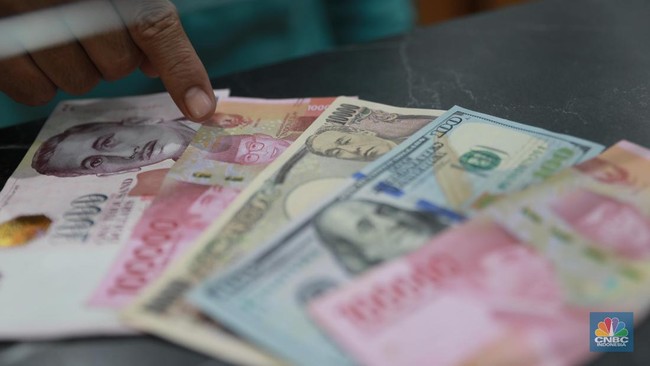
Asian currencies moved diversely against the US Dollar in trading on Thursday (10/09/2026).
According to Refinitiv data as of 09:20 WIB, out of 10 monitored Asian currencies, five strengthened against the US Dollar, four weakened, and one remained stagnant. The South Korean Won recorded the sharpest appreciation in Asia this morning, rising 0.16% to KRW 1,337.6/US$.
The Japanese Yen and Singapore Dollar both strengthened by 0.04%, reaching JPY 153.46/US$ and SGD 1.2634/US$ respectively. The Malaysian Ringgit also moved positively with a 0.02% gain to MYR 4.067/US, whiletheChineseYuanroseslightlyby0.01.
Conversely, the Indonesian Rupiah experienced the deepest pressure in Asia this morning. The ‘Garuda’ currency weakened by 0.11% to Rp17,520/US, althoughitremainsnearitsstrongestlevelinalmost17weeks.ThePhilippinePesoalsocorrectedby0.05, followed by the Taiwan Dollar weakening by 0.04% to TWD 31.484/US, andtheThaiBahtdroppingby0.03. Meanwhile, the Vietnamese Dong remained stagnant at VND 25,904/US$.
Asian currency movements this morning continue to be influenced by US Dollar dynamics. The US Dollar Index (DXY) was observed to have weakened by 0.09% to 98.731. The US Dollar remains under pressure as the Japanese Yen has strengthened in recent days. The greenback is even trading near its seven-month low against the Yen, as markets closely monitor the upcoming policy directions of the US Federal Reserve and the Bank of Japan (BOJ) next week.
“The main story is the US policy premium limiting the dollar’s rise, while the yen strengthens supported by the US Treasury,” said Kevin Ford, FX & Macro strategist at Convera, as quoted by Reuters. The Yen remains a primary market focus after strengthening by approximately 4% throughout September. This appreciation is beginning to disrupt carry trade calculations—a strategy involving borrowing low-cost Yen to invest in higher-yielding assets or currencies.
The Yen’s strength is supported by expectations of faster BOJ policy tightening, the potential repatriation of funds by Japanese investors from abroad, and pressure from Washington for a stronger Yen. The market widely expects the BOJ to raise interest rates by 25 basis points at its meeting on 17-18 September, though further Yen appreciation will depend on policy signals from BOJ Governor Kazuo Ueda.
On the other hand, the US Dollar is still being restrained by rising oil prices. Brent crude rose by 3.36% to close at US$101.21 per barrel, its highest level since May, following increased conflict in the Middle East. The Iran-backed Houthi group launched attacks on several cities in Saudi Arabia, while US forces attacked several Iranian oil tankers, and Iran targeted US bases in Jordan.
The rise in oil prices has caused markets to refocus on global inflation risks. This is critical as US inflation data, to be released on Friday, will serve as a key benchmark ahead of next week’s Fed meeting. OCBC noted that the recent escalation in the Middle East has brought the impact of energy prices on Fed policy back into focus, particularly after last week’s strong US labour report revived expectations of interest rate hikes.
The US Dollar also briefly halted its decline after the US Treasury announced it would double the size of its long-term bond buyback operations on Thursday, with purchases of up to US$6 billion.
Source: jawawa.id (https://jawawa.id/newsitem/asian-currencies-split-yen-and-won-strengthen-rupiah-most-weakened-1789012801)
Originally published by CNBC Indonesia (https://www.cnbcindonesia.com/research/20260910092710-128-766805/mata-uang-asia-terbelah-yen--won-menguat-rupiah-paling-terpuruk), translated from Indonesian