
Asian Currencies Slide, but the Rupiah and Taiwan Dollar Gain
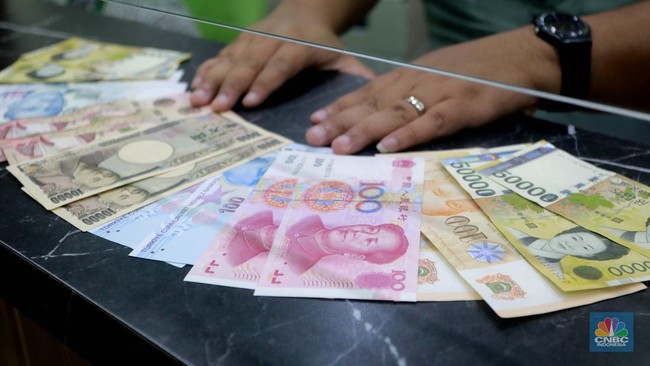
Jakarta, CNBC Indonesia — Pressure again dominated Asian foreign exchange markets on Wednesday (21 October 2026). Although the US dollar remained under pressure, most regional currencies were unable to capitalise on the weakness to strengthen.
According to Refinitiv data at 9.23am Western Indonesian Time, seven of the 10 Asian currencies monitored were weaker against the US dollar. Only three managed to remain in positive territory.
The Taiwan dollar posted the strongest gain in morning trading, rising 0.13%.
The Malaysian ringgit followed, up 0.05%. The rupiah also remained in positive territory, edging up 0.02% to Rp17,977 per US dollar and moving back below the psychological Rp18,000 threshold.
At the other end, the Philippine peso came under the heaviest pressure, falling 0.25%.
The Thai baht followed with a decline of 0.18%, while the South Korean won weakened 0.10%.
The Japanese yen fell 0.06%, while the Chinese yuan and Singapore dollar both slipped 0.04%. The Vietnamese dong was down a marginal 0.01%.
The US dollar itself failed to find fresh momentum in morning trading. The US dollar index (DXY) was down 0.04% at 101.745.
That left the DXY near a three-week low. On Tuesday, the index had already fallen by around 0.20% to 101.78.
The greenback weakened as US Treasury yields and oil prices fell, slightly reducing the dollar’s appeal as a safe haven.
Oil prices had retreated after briefly reaching a five-month high. Markets were weighing the prospect of an easing in the Middle East conflict following a meeting between Iran’s president and Pakistan’s military chief, who has acted as one of the intermediaries between the US and Iran.
Geopolitical risks, however, have not disappeared. Houthi attacks on Saudi infrastructure are continuing, while reports of attacks on ships in the Gulf region have also kept markets cautious.
At the same time, improving equity markets reduced some demand for the dollar as a safe-haven asset. Wall Street rose as the technology earnings season began, while Japanese and South Korean stock indices also advanced on Wednesday.
“With market sentiment and growth prospects so closely tied to the performance of large technology companies, their earnings reports could have a major influence on the US dollar,” said Carol Kong, an economist and currency strategist at Commonwealth Bank of Australia, as quoted by Reuters.
Kong said the US dollar had so far been one of the most prominent safe-haven assets. However, demand for the greenback as a refuge could ease if the Middle East conflict subsides and energy prices fall.
Markets are also preparing for a series of central bank decisions next week. The Federal Reserve, European Central Bank and Bank of Japan are scheduled to announce policy decisions on three consecutive days, starting next Wednesday.
Source: jawawa.id (https://jawawa.id/newsitem/asian-currencies-slide-but-the-rupiah-and-taiwan-dollar-gain-1792554636)
Originally published by CNBC Indonesia (https://www.cnbcindonesia.com/research/20261021092922-128-778081/mata-uang-asia-berguguran-rupiah--dolar-taiwan-justru-perkasa), translated from Indonesian