
Asian Currencies: Rupiah and Ringgit Fall, Won, Yen, Yuan Soar
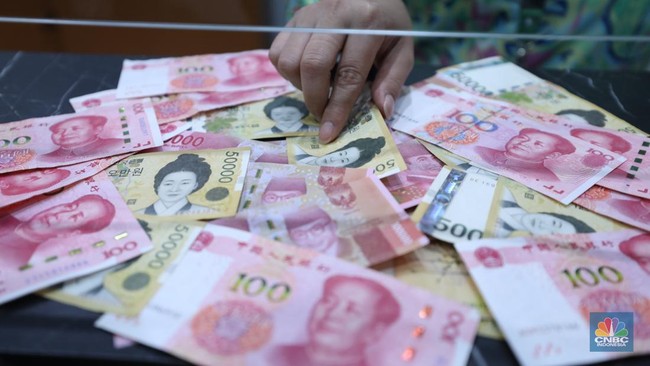
Jakarta, CNBC Indonesia – Asian currencies were split in their movement against the US dollar in Thursday’s trading (23/7/2026). The weakening of the US dollar on the global market has not yet been able to push all currencies in the region into the green zone.
According to Refinitiv data as of 09.15 WIB, of the 10 Asian currencies, five strengthened against the US dollar, while the other five weakened.
The rupiah was one of the currencies still under pressure this morning. The Garuda currency weakened 0.20% to Rp17,910/US.ThispositionputstherupiahbackaboveRp17, 900/US.
Pressure was also felt by the Thai baht, which weakened 0.06% to THB 33.77/US, followedbytheMalaysianringgit, whichcorrected0.05.
The Philippine peso also slipped slightly, down 0.02% to PHP 61.732/US, whilsttheVietnamesedongweakened0.01.
On the other hand, the South Korean won was the strongest gainer in Asia. The won surged 0.67% to KRW 1,467.2/US$.
The Taiwan dollar also strengthened solidly, up 0.39% to TWD 32.254/US.TheSingaporedollarrose0.09.
The Japanese yen also strengthened 0.06% to JPY 163.05/US$, whilst the Chinese yuan rose 0.06% against the US dollar.
Meanwhile, the US dollar index (DXY), which measures the strength of the US dollar against six major world currencies, was seen weakening 0.07% to 101.056 this morning.
The US dollar eased slightly after recording gains over recent days. Previously, the greenback rose as renewed US-Iran war tensions pushed oil prices higher and reignited inflation worries.
Oil prices had touched their highest level in around six weeks. US crude oil rose 2.93% to US$86.81 per barrel, whilst Brent gained 3.34% to US$94.05 per barrel. The rise in oil prices came as the market grew concerned again about disruptions to global energy supplies.
Tensions escalated again after US President Donald Trump vowed to destroy an Iranian bridge or power plant every time Iran fired on ships in the Strait of Hormuz. This statement marked the latest escalation after the Iran-aligned Houthi group in Yemen threatened the second vital energy route.
Even so, the market still sees room for diplomacy. A senior Iranian official told Reuters on Monday that mediators had submitted a proposal for a 10-day ceasefire to Tehran.
Juan Perez, director of trading at Monex USA in Washington, believes the market is beginning to try to read the prospects of a conflict resolution from a different perspective.
“There are negotiations going on behind the scenes, so ultimately the market is trying to look at it from a different angle, not always a more positive one,” said Perez, quoted by Reuters.
According to Perez, excessive escalation has actually led the market to believe there will be a swift effort to end the conflict.
“Because generally the scale is so large and the escalation has gone too far, there will be an urgent effort to end it quickly. That’s the narrative and it helps the market, and it’s not a very positive thing for the dollar,” he added.
On the other hand, expectations of a US central bank (The Federal Reserve/The Fed) rate hike rose again in line with the increase in oil prices. Based on CME FedWatch, the market now estimates a 31.5% chance of a rate hike at the July meeting, up from 10.7% the previous week.