
Asian Currencies Routed as Yen, Ringgit Tumble; Rupiah Hit Hardest
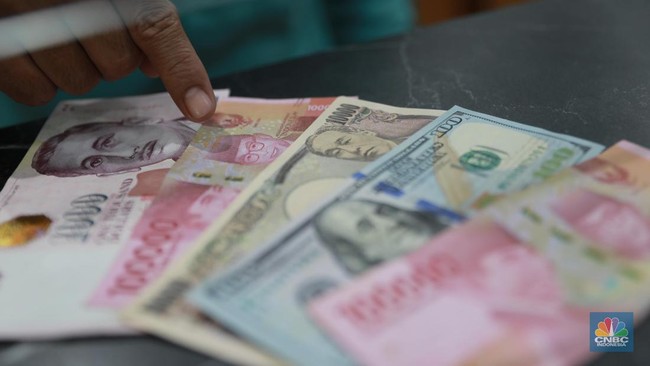
All Asian currencies weakened against the US Dollar (US$) in trading on Wednesday (1/7/2026). Pressure intensified as the US Dollar Index (DXY) regained strength.
According to Refinitiv data as of 09:45 WIB, out of the 10 monitored Asian currencies, all were simultaneously pressured by the US Dollar. The deepest pressure was experienced by the South Korean Won, which weakened by 0.65% to KRW 1,557/US$. The Indonesian Rupiah followed as the second deepest depreciating currency in Asia.
The ‘Garuda’ currency weakened by 0.53% to the level of Rp17,970/US, bringingtheRupiahclosertothepsychologicallevelofRp18, 000/US.
The Philippine Peso also corrected sharply, dropping 0.42% to PHP 61.580/US.TheThaiBahtweakenedby0.30, followed by the Vietnamese Dong, which fell 0.24% to VND 26,319/US$.
The Malaysian Ringgit also entered the red zone after weakening by 0.20% to MYR 4.090/US.TheSingaporeDollarfellby0.19, while the Taiwan Dollar weakened by 0.16% to TWD 31.829/US$.
Pressure was also visible on the Japanese Yen, which corrected by 0.14% to JPY 162.76/US$. Although its decline was not as deep as other Asian currencies, the Yen’s position is now at its weakest level in 40 years, or since 1986.
The Chinese Yuan also weakened slightly by 0.11% to CNY 6.7927/US$.
The widespread weakening of Asian currencies this morning occurred amidst the strengthening of the US Dollar in global markets. This was reflected in the movement of the US Dollar Index (DXY), which measures the strength of the greenback against six major world currencies; as of 09:4s WIB, it was observed to have strengthened by 0.12% to 101.311. The DXY moved upward again after having weakened at the start of the week.
The strengthening of the US Dollar was driven by investors awaiting the release of the latest monthly US employment data. This data will serve as a crucial indicator for reading labour market strength and the direction of US central bank (The Federal Reserve/The Fed) interest rate policy.
The US Dollar also received support from the rise in US government bond yields. The 10-year US Treasury yield rose by approximately 10 basis points in the previous session, making dollar-based assets more attractive to investors.
Regarding economic data, US job vacancies in May rose to a two-year high. Data released on Tuesday showed the number of job openings increased by 9,000 to 7.594 million. This figure was higher than market expectations of 7.296 million and also exceeded the revised April figure of 7.585 million.
The strength of the job vacancy data indicates that US labour demand remains quite solid, despite signs that hiring is beginning to slow. This condition has led the market to reconsider the possibility that the Fed will maintain its hawkish stance for longer.
Following the interest rate announcement in June, Fed officials signalled that rate hikes could still occur this year. At the June meeting, the Fed maintained its benchmark interest rate at a level of 3.50% to 3.75%.
Based on the CME FedWatch Tool, market participants are now pricing in a 33.70% probability that the Fed will raise interest rates by 25 basis points at the July 28-29 meeting. Meanwhile, the probability of rates being held steady stands at 66.30%.
Beyond interest rate factors, investors are also closely monitoring US-Iran peace talks in Qatar. Hopes for a long-term ceasefire remain, even though both parties are not expected to hold direct talks.