
Asian Currencies: Ringgit and Won Conquer Dollar, Yuan and Rupiah Struggle
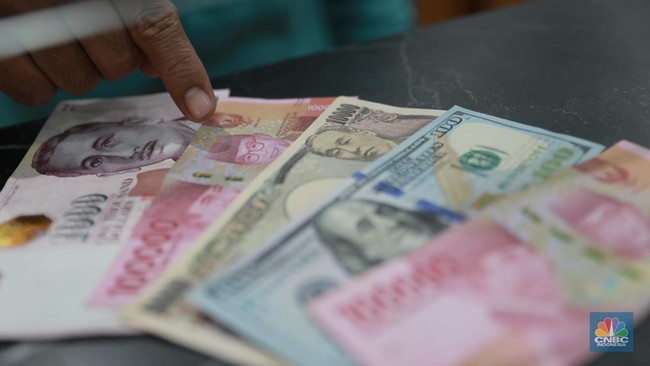
Jakarta, CNBC Indonesia - Asian currency movements against the US dollar were mixed in trading on Tuesday (23/6/2026). Markets remained overshadowed by expectations of a more hawkish policy stance from the US central bank, The Federal Reserve (The Fed).
Referring to Refinitiv data as of 09.15 WIB, of 10 Asian currencies, five weakened against the US dollar, four strengthened, and one was stagnant.
The Philippine peso was the currency under the deepest pressure in Asia this morning. The peso weakened 0.40% to PHP 61.221/US.TheThaibahtalsocameunderpressureaftercorrecting0.21. The rupiah followed with a depreciation of 0.14% to Rp17,850/US, keepingtheGarudacurrencymovingabovethepsychologicallevelofRp17, 800/US.
Lighter pressure was seen on the Vietnamese dong, which weakened 0.03%, while the Chinese yuan corrected a marginal 0.01% against the US dollar.
On the other hand, the Malaysian ringgit was the currency with the sharpest strengthening in Asia after rising 0.29% to MYR 4.134/US.TheSouthKoreanwonalsostrengthened0.25.
The Taiwan dollar rose a slight 0.02% to TWD 31.596/US, whiletheJapaneseyenstrengthenedverymarginallyby0.01. Despite the strengthening, the yen’s position remains in a weak area and near its lowest level in about four decades.
Meanwhile, the Singapore dollar moved stagnant at SGD 1.292/US$.
The US dollar index (DXY) was observed weakening a marginal 0.02% to 101.001 at the same time. Although slightly lower, the DXY position remained at a high level, so pressure on Asian currencies has not fully subsided.
The US dollar remained quite strong on Tuesday as market participants increasingly priced in the chance of a more hawkish Fed stance. Fed funds futures now estimate the probability of a rate hike in September reaching 75%.
Several major institutions have also begun to change their views. BofA Global Research and Deutsche Bank no longer expect the Fed’s interest rate to hold steady, and now see a chance of a rate hike this year as the US economy remains strong.
Sim Moh Siong, FX strategist at OCBC, assessed that the US dollar remains strong due to rising yields and hawkish Fed expectations.
OCBC now expects the US dollar to move slightly stronger amid increased risks of tighter US monetary policy. This view changed from previous projections that expected the dollar to move in a limited range.
Besides the Fed factor, the US dollar also received support from oil price movements. Oil prices rose again on Tuesday after falling sharply in the previous session due to developments in US-Iran peace talks.
Investors are still awaiting further clarity regarding the restoration of oil flows through the Strait of Hormuz. As long as this certainty has not emerged, energy price risks remain a market concern.
For Asian currencies, the combination of higher US rate hike expectations and rising oil prices limits room for appreciation. This is reflected in the mixed movements of regional currencies this morning, with the rupiah and Philippine peso among those under pressure.