
Asian Currencies Mostly Strengthen, but the Rupiah and Yen Weaken
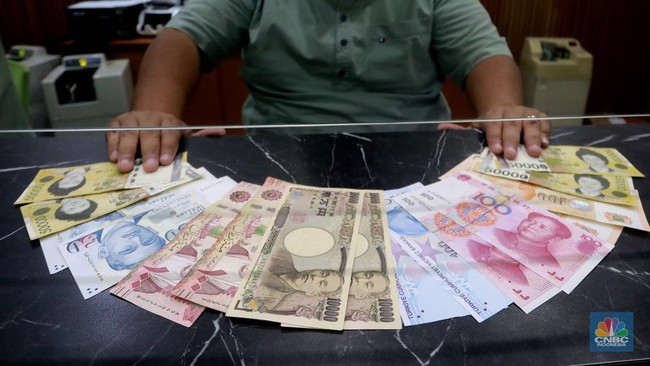
Jakarta, CNBC Indonesia – Towards the end of the week, Asian currencies generally performed better against the US dollar. However, not all were able to benefit from the momentum in trading on Friday (23 October 2026).
Refinitiv data at 9.22 am Western Indonesian Time showed that six of the 10 Asian currencies tracked had strengthened against the US dollar, while the other four remained in negative territory.
The South Korean won and Philippine peso recorded the biggest gains that morning. Both rose 0.11%, with the won at KRW1,323.61 per US dollar and the peso at PHP63.361 per US dollar.
The Taiwan dollar followed with a 0.06% gain, while the Vietnamese dong rose 0.04%. The Chinese yuan and Thai baht each gained 0.03%.
In contrast to most regional currencies, the rupiah remained in negative territory. The Indonesian currency slipped 0.03% to Rp18,050 per US dollar, keeping it above the psychological threshold of Rp18,000 per US dollar.
The Japanese yen also weakened, by 0.06%, followed by the Malaysian ringgit, which fell 0.05%. The Singapore dollar edged down 0.02%.
Despite gains by most Asian currencies, the US dollar itself moved slightly higher. At the same time, the US Dollar Index, or DXY, rose 0.07% to 101.679.
The morning’s increase was limited, but the dollar remained at a relatively high level. Recently, the DXY briefly reached 102.9, its highest level since April 2025, before retreating to around 101.
On an annual basis, the DXY has risen by about 3.3% compared with its level at the end of 2025.
The dollar’s strength in recent months has been supported by still-high US interest rates, a surge in energy prices linked to conflict in the Middle East, and demand for the greenback when market uncertainty rises.
However, an excessively strong dollar also has consequences for the US economy. Zafer Ergezen, a futures and commodities market analyst, said that a stronger dollar could reduce the competitiveness of US products in global markets.
“The dollar is strengthening, interest rates are rising, and inflation is increasing ahead of the midterm elections. This is not something Trump wants, because mortgage repayments are also rising and many goods are becoming more expensive. The clearest example is petrol prices,” Ergezen said.
He said the dollar’s direction and the outlook for the US economy would also be heavily influenced by developments in the Middle East conflict after the US midterm elections.
“I think there will be very serious developments in the US/Israel-Iran war after the election. Depending on the outcome, a lasting agreement may be reached, or the war could escalate to an entirely different level,” he said.
Source: jawawa.id (https://jawawa.id/newsitem/asian-currencies-mostly-strengthen-but-the-rupiah-and-yen-weaken-1792727452)
Originally published by CNBC Indonesia (https://www.cnbcindonesia.com/research/20261023092908-128-778795/mata-uang-asia-ramai-ramai-menguat-rupiah-yen-malah-menangis), translated from Indonesian