
Asian currencies mostly rise, but rupiah slumps to record low
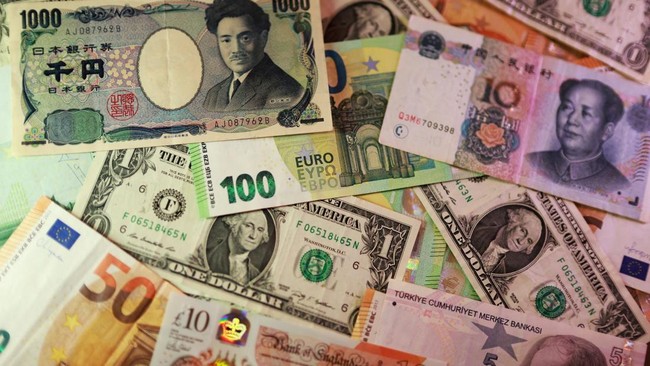
The US dollar’s gains were not enough to halt most Asian currencies on Thursday (26 November 2026). Most regional currencies traded higher, while the rupiah came under the greatest pressure.
Refinitiv data at 10.00am Jakarta time showed that eight of the 10 monitored Asian currencies had strengthened against the US dollar. Only the rupiah and Vietnamese dong were weaker.
The Taiwan dollar led the gains, rising 0.62% to TWD32.955 per US dollar. The South Korean won followed, up 0.27% to KRW1,340.88 per US dollar.
The Chinese yuan and Thai baht each gained 0.18%, to CNY6.6634 and THB33.98 per US dollar, respectively.
The Malaysian ringgit appreciated 0.07% to MYR4.114 per US dollar, followed by the Singapore dollar, which rose 0.05% to SGD1.2897 per US dollar.
The Philippine peso gained 0.04% to PHP63.593 per US dollar, while the Japanese yen recorded the smallest increase, at 0.02%, to JPY159.14 per US dollar.
By contrast, the rupiah suffered the steepest decline, depreciating 0.35% to Rp18,380 per US dollar and touching its weakest level on record. The Vietnamese dong was the only other currency to fall, down 0.05% to VND25,838 per US dollar.
Meanwhile, the US dollar index (DXY) was up 0.07% at 103.735 at 10.00am Jakarta time.
Although the dollar edged higher in Asian trading on Thursday morning, it had lost some momentum after reaching a 19-month high earlier in the week. Falling US Treasury yields were among the factors limiting gains in the greenback.
Reuters reported that the DXY fell 0.15% on Wednesday (25 November 2026), as US Treasury yields declined and investors adopted a cautious stance ahead of the Thanksgiving holiday.
The 10-year US Treasury yield fell six basis points to 4.84%, while the two-year yield dropped four basis points to 4.633% and the 30-year yield fell seven basis points to 5.227%.
However, expectations of Federal Reserve rate rises continued to support the dollar. US core personal consumption expenditures (PCE) inflation for October came in higher than expected, while an upward revision to third-quarter economic growth strengthened expectations that the central bank would continue monetary tightening.
Markets are now pricing in a 25-basis-point rate rise in December, followed by the possibility of another increase in early 2027.
“From a risk-reward perspective, chasing further dollar gains now looks less attractive. However, the risk of a more hawkish Fed policy will continue to support the dollar,” said Sim Moh Siong, an FX strategist at OCBC, according to Reuters.
Markets are also monitoring the Donald Trump administration’s plan to impose new tariffs on goods from 14 major US trading partners. The policy has revived concerns about inflationary pressures and global trade.
Trading is expected to be more subdued on Thursday because most US financial markets are closed for Thanksgiving. Thinner liquidity could make currency movements more sensitive to market transactions.
Source: jawawa.id (https://jawawa.id/newsitem/asian-currencies-mostly-rise-but-rupiah-slumps-to-record-low-1795665043)
Originally published by CNBC Indonesia (https://www.cnbcindonesia.com/research/20261126095925-128-788604/mata-uang-asia-ijo-royo-royo-yen-won-menguat-tapi-rupiah-melemah), translated from Indonesian