
Asian Currencies Mixed: Won Weakens While Rupiah and Ringgit Strengthen
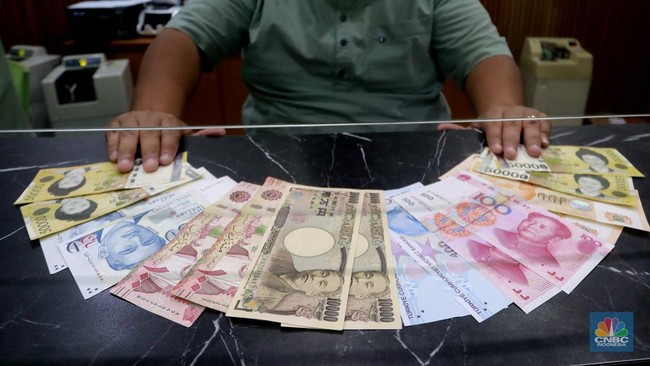
Asian currencies moved in different directions against the United States dollar on Wednesday (15/7/2026). According to Refinitiv data as of 09:15 Western Indonesia Time, five of the ten monitored Asian currencies strengthened, four weakened, and one remained stagnant.
The Malaysian ringgit recorded the sharpest gain, rising 0.27% to MYR 4.065 per US dollar. The Indonesian rupiah followed, appreciating 0.22% to Rp18,040 per US dollar. The Japanese yen also strengthened 0.10% to JPY 162.05 per US dollar, followed by the Thai baht which rose 0.06% to THB 33.48 per US dollar. The Chinese yuan moved positively with a 0.05% gain to CNY 6.766 per US dollar.
On the other hand, the South Korean won was under the deepest pressure, weakening 0.13% to KRW 1,490.96 per US dollar. The Singapore dollar also fell 0.07% to SGD 1.289 per US dollar, while the Philippine peso corrected 0.06% to PHP 61.609 per US dollar. The Vietnamese dong edged down 0.02% to VND 26,265 per US dollar. The Taiwan dollar remained stagnant at TWD 32.141 per US dollar.
Meanwhile, the US dollar index (DXY) was observed strengthening 0.12% to 100.798 this morning. This slight gain came after the greenback had previously slumped sharply by 0.31% in its last session. The US dollar weakened against several major world currencies after US inflation data for June came in lower than expected, temporarily easing market expectations for policy tightening by the Federal Reserve.
At the same time, Federal Reserve Chair Kevin Warsh gave his inaugural testimony before the US Congress. Warsh stated that the central bank has no tolerance for persistently high inflation and noted that if the Fed’s policies are implemented correctly, the inflation surge of the last five years could become a thing of the past.
However, market participants are not yet fully convinced that inflationary pressures have truly subsided. The re-escalating US-Iran conflict is driving energy prices higher and keeping the possibility of a Fed rate hike alive. Uto Shinohara, senior investment strategist at Mesirow Currency Management, assessed that the inflation outlook remains unclear despite the softer US CPI data.
Tensions in the Gulf have also increased, with US and Iranian forces launching attacks on each other, nearly halting maritime traffic through the Strait of Hormuz again. This situation has pushed benchmark Brent crude oil prices above US$85 per barrel. Consequently, investors are once again scrutinising inflation risks stemming from energy prices. If oil prices remain elevated, global inflationary pressures could rise again and prompt central banks to maintain tight policies for longer.
The probability of a Fed rate hike in July has indeed fallen to 16% from 42% on Monday (13/7/2026), based on the CME FedWatch Tool. However, the likelihood of a rate hike this year remains quite substantial at around 80%. Fed Governor Christopher Waller previously stated that rates might need to rise in the near term if data shows inflation is still far above the 2% target.
Shawn Snyder, economic strategist at Potomac Fund Management, assessed that the Fed’s hawkish stance on inflation could still provide room for the US dollar to strengthen again. Snyder added that if Chair Warsh is serious about making the five-year inflation surge a thing of the past, the market must consider whether this tightening cycle will be slightly more painful than currently anticipated, which could lead to further dollar strength.