
Asian Currencies Mixed: Ringgit and Rupiah Weaken, Won Holds Firm
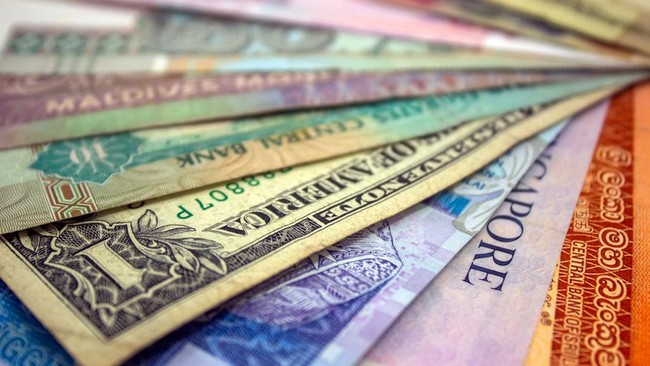
Jakarta, CNBC Indonesia – The majority of Asian currencies weakened against the US dollar in Wednesday trading (22/7/2026). The pressure came as the US dollar held at high levels after strengthening sharply in the previous session.
According to Refinitiv data, seven currencies faced pressure from the greenback, while three others managed to strengthen as of 09.15 WIB.
The rupiah fell into the red zone as well. The Garuda currency weakened 0.17% to Rp17,910 per US dollar, returning to the Rp17,900 level after closing stronger at Rp17,880 on Tuesday.
The deepest pressure this morning was felt by the Thai baht, which weakened 0.21% to THB 33.75 per US dollar. The Malaysian ringgit followed with a 0.15% decline to MYR 4.093 per US dollar.
The Vietnamese dong also corrected 0.08% to VND 26,331 per US dollar, while the Chinese yuan weakened 0.07% to CNY 6.7702 per US dollar. The Philippine peso fell 0.06% to PHP 61.761 per US dollar, and the Singapore dollar slipped marginally by 0.01% to SGD 1.291 per US dollar.
On the other side, the South Korean won and the Taiwanese dollar were the two strongest performers in Asia, each gaining 0.10% against the US dollar. The won stood at KRW 1,479.9 per US dollar, while the Taiwanese dollar was at TWD 32.294 per US dollar.
The Japanese yen also edged up 0.01% to JPY 163.15 per US dollar, though it remains at a very weak level against the greenback.
This morning’s currency movements took place amid developments in the Middle East war and their influence on the US dollar index (DXY).
The index, which measures the greenback’s strength against six major world currencies, was stable at 101.174 this morning. However, at Tuesday’s close (21/7/2026), the DXY recorded a 0.22% gain and moved back above the 101 level, one factor limiting the room for Asian currencies to move this morning.
The main sentiment came from the latest attacks in the Middle East, which pushed oil prices higher again and triggered fears of more prolonged inflation.
Tensions also escalated after two tankers carrying Saudi crude oil to Asia were reported to have turned around in the Red Sea following threats from the Iran-aligned Yemeni Houthi group. The widening Middle East conflict has also disrupted shipping routes through two key global energy chokepoints.
At the same time, the US military said it had completed its latest round of strikes against Iran on Monday, marking the tenth consecutive night of US operations against Iran.
Oil prices rose again as a result. US crude climbed 2.09% to US$84.97 per barrel, while Brent gained 1.88% to US$90.90 per barrel after touching US$91.99, its highest level since 11 June.
The rise in oil prices has refocused market attention on inflation risks. Earlier, optimism over a US-Iran peace deal had pushed oil prices down and cooled expectations of a Fed rate hike. However, oil prices have reversed upwards over the past few days as regional tensions have heated up once more.
Comments from a number of Fed officials, including Fed Chair Kevin Warsh, have also continued to signal concerns about inflationary pressure.
Erik Bregar, director of FX and precious metals risk management at Silver Gold Bull in Toronto, believes the market has begun pricing in the ongoing escalation of the conflict.
‘We are now on the tenth night of strikes on Iran, so the market is rationally pricing in this situation,’ Bregar said, quoted by Reuters.
Bregar also assessed that the Fed’s stance remains hawkish, particularly if the Middle East conflict continues and keeps inflationary pressure elevated.
‘The Fed is hawkish, and I don’t think the market has fully priced that in. The longer this conflict lasts in the Middle East, the higher the risk that the Fed sounds more hawkish,’ he said.
Despite the high tensions, diplomatic efforts have not entirely ceased. A senior Iranian official told Reuters on Monday that Tehran had accepted a 10-day ceasefire proposal from mediators.
However, US President Donald Trump said there would be a response if the Yemeni Houthi group actually carried out its threat to blockade commercial shipping in the Red Sea.
On the interest rate front, market expectations of a Fed rate hike have also started to climb again. Based on CME FedWatch, the probability of a rate hike of at least 25 basis points at next week’s meeting rose to 21.9%, from around 11% last week. For the September meeting, the market is pricing in a 68.2% chance of a rate hike.