
Asian Currencies in Heavy Decline, Only This Country Survives
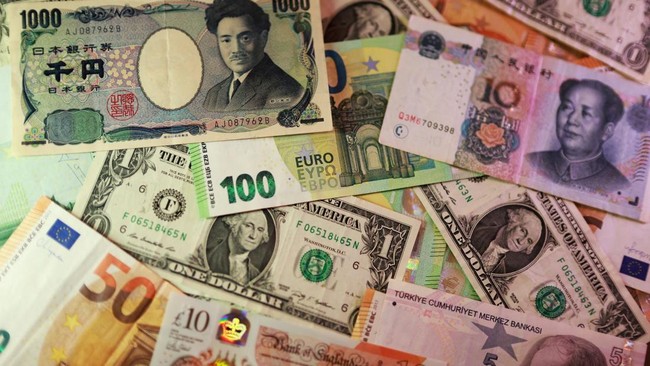
Jakarta, CNBC Indonesia - The majority of Asian countries’ currencies moved in a weakening zone against the US dollar on this morning’s trading, Monday (13/4/2026). This comes as the US dollar is once again sought by investors following the failure of the Washington-Teheran peace negotiations to yield an agreement.
According to Refinitiv data, as of 09.10 WIB, out of 10 Asian currencies, nine experienced weakening and only one strengthened against the greenback.
The deepest weakening occurred in the Thai baht, which fell 0.94% to THB32.26/US.ThePhilippinepesofollowed, weakening0.89.
Pressure was also evident in the South Korean won, which dropped 0.32% to KRW1,489.4/US.Meanwhile, therupiahexchangeratewasalsopressuredbythegreenback, weakeningby0.29, while the Japanese yen weakened 0.25% to JPY159.68/US$ and the Malaysian ringgit fell 0.25% to MYR3.970/US$.
Next, the Singapore dollar weakened 0.22% to SGD1.2759/US, theTaiwandollarfell0.11, and the Chinese yuan weakened 0.09% to CNY6.8339/US$.
Meanwhile, the only currency that managed to hold in the green zone is the Vietnamese dong, which strengthened 0.08% to VND26,315/US$.
This movement aligns with the strengthening of the US dollar. The US dollar index (DXY) was recorded strengthening 0.38% to 99.021 at the same time.
The US dollar is being hunted by investors after lengthy negotiations between Washington and Teheran were reported to have failed to produce a peace agreement, thus pushing the market back into a longer period of uncertainty.
US President Donald Trump also stated that the US Navy will begin implementing a blockade in the Strait of Hormuz, a strategic route that channels around 20% of the world’s daily energy supply and has been effectively closed since the war began at the end of February.
This situation has driven oil prices to strengthen again, amplifying concerns over a broader surge in inflation.
Previously, the market had welcomed a two-week ceasefire announced on 7 April with oil selling and capital flows returning to risk assets. However, concerns over the fragility of that agreement prompted a reversal of positions, making the US dollar the primary destination as a safe haven once more.
This condition ultimately led market players to chase the US dollar. In turn, the room for strengthening in other countries’ currencies has narrowed further, including Asian countries’ currencies in this morning’s trading.