
Asian Currencies Face Divergent Fates: Yen Soars and Allies, Rupiah Crashes Worst
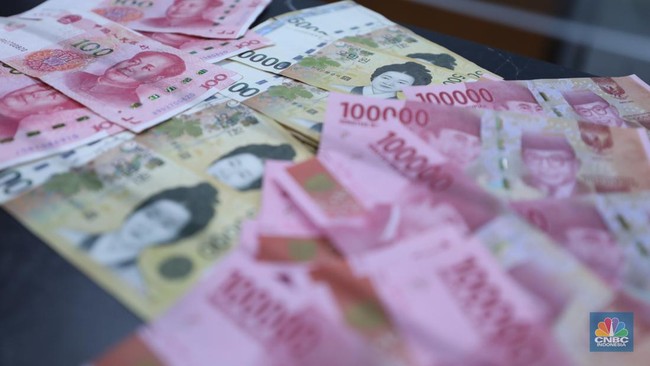
Asian currencies moved diversely against the US dollar on trading today, Thursday (30/4/2026). Following the US central bank (The Federal Reserve/The Fed) holding its benchmark interest rate steady again.
Referring to Refinitiv data at 09:15 WIB, out of 11 monitored Asian currencies, 6 strengthened, 3 weakened, and 2 remained stagnant.
The rupiah became the Asian currency under the deepest pressure this morning. The Garuda’s currency weakened 0.49% to Rp17,360/USD.
After the rupiah, pressure was also felt by the Malaysian ringgit, which stood at MYR 3.962/USD after weakening 0.30%. The Vietnamese dong also corrected 0.09% to VND 26,355/USD.
On the other hand, the Philippine peso became the Asian currency with the largest strengthening.
The peso stood at PHP 61.46/USD after rising 0.18%. The Korean won followed with a 0.15% strengthening to KRW 1,468.24/USD, while the Japanese yen stood at JPY 160.22/USD or strengthened 0.10%.
The Thai baht also rose 0.09% to THB 32.68/USD, followed by the Singapore dollar which strengthened 0.07% to SGD 1.28/USD. The Taiwan dollar also moved positively 0.05% to TWD 31.611/USD.
Meanwhile, the Chinese yuan and Indian rupee tended to stagnate. The yuan stood at CNY 6.83/USD, while the Indian rupee stood at INR 94.85/USD.
Today’s Asian currency movements are still influenced by the dynamics of the US dollar in the global market. The US dollar index or DXY at 09:15 WIB was observed to weaken slightly by 0.05% to 98.913.
However, in the previous trading session, DXY closed stronger by 0.33% to 98.961.
That strengthening occurred after The Fed decided to hold interest rates again, so the market is scrutinising the future direction of US monetary policy more closely, especially after the meeting showed quite sharp differences in views within The Fed.
This time’s Fed decision was taken by a vote of 8 to 4, becoming the most divided decision since 1992.
This situation opens up challenges that Kevin Warsh will face when he later serves as Fed Chairman, especially if he wants to push for interest rate cuts. Jerome Powell’s term as Fed Chairman ends on 15 May.
In a press conference, Powell stated that although four Fed officials rejected maintaining the easing bias, he does not see the US central bank heading towards rate hikes.
Besides the Fed factor, the market is also still overshadowed by the US-Israel war with Iran, which shows no signs of abating. This uncertainty also keeps demand for the US dollar as a safe-haven asset.
US President Donald Trump is reportedly discussing ways to reduce the impact of a possible Iranian port blockade for several months with US oil companies. This situation has increased concerns about global energy supplies again.
Oil prices even rose for the eighth consecutive session, becoming the longest rally since the Russian invasion of Ukraine in May 2022. The June Brent contract, expiring on Wednesday, surged 6% and closed at US$118.03 per barrel.