
Asian Currencies Diverge: Won and Yen Gain, Rupiah Suffers the Sharpest Fall
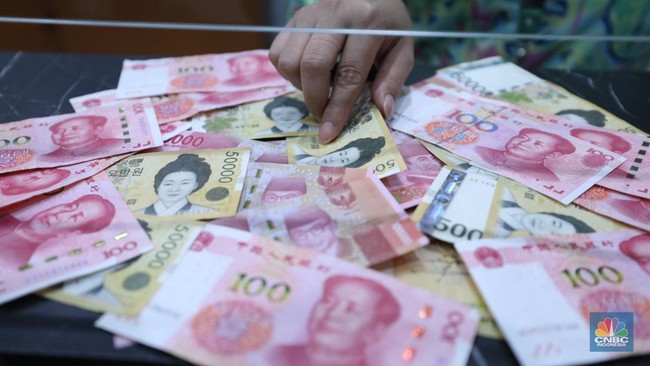
Asian foreign-exchange markets moved in mixed directions on Thursday (22 October 2026).
As of 9.20 am Western Indonesian Time, six of the 10 Asian currencies tracked by Refinitiv had weakened against the US dollar, while the other four posted gains.
The South Korean won was the strongest, rising 0.20% to KRW1,324 per US dollar. The Japanese yen followed, gaining 0.14% to JPY157.92 per dollar. The Vietnamese dong and Chinese yuan also rose, by 0.07% and 0.01%, respectively.
The rupiah, by contrast, came under the most pressure. Indonesia’s currency fell 0.25% to Rp18,045 per US dollar, moving back above the psychological threshold of Rp18,000.
The Taiwan dollar recorded the next steepest decline after the rupiah, losing 0.24%. The Philippine peso fell 0.11%, while the Thai baht, Malaysian ringgit and Singapore dollar slipped 0.06%, 0.04% and 0.03%, respectively.
The greenback was showing signs of weakness, with the US dollar index (DXY) down 0.06% at 101.717.
Despite the decline, the DXY remained above 101, indicating that the US dollar had not completely lost its strength ahead of a series of interest-rate decisions by major central banks around the world next week.
Many market participants are still holding dollars on the view that the US economy will remain strong, supported in part by developments in the artificial intelligence (AI) industry.
Continued economic growth has fuelled expectations that US interest rates could remain high for longer.
However, long positions in the dollar have begun to ease somewhat. This is reflected in gains by several major currencies, including sterling, the Canadian dollar, the Australian dollar and the New Zealand dollar, which have recently touched their highest levels against the greenback in several weeks.
Markets are now preparing for a crucial week for global monetary policy. The Federal Reserve (Fed), European Central Bank (ECB) and Bank of Japan (BOJ) will announce interest-rate decisions in quick succession next week.
The three central banks are expected to leave rates unchanged at their upcoming meetings. Markets will nevertheless scrutinise the tone of their statements for clues about their next moves.
The Fed is expected to hold rates in a range of 3.75% to 4.00% in October. Markets still see the possibility of a rate rise in December.
In Europe, the ECB is expected to keep its benchmark rate at 2.5% next week. Markets continue to factor in a possible increase before the end of the year.
In Japan, the BOJ is also expected to leave rates unchanged at its next meeting. The next increase, to 1.5%, is not expected until early next year.
These expectations have helped the yen hold its ground. The Japanese currency is trading at around 158 per US dollar, with the threat of intervention by Japanese authorities and the prospect of a BOJ rate rise limiting further weakness.
The euro, meanwhile, remains under pressure from France’s fiscal problems and Europe’s energy situation.
The yield on France’s 10-year government bonds reached its highest level since 2022 on Wednesday. Social unrest in France has again highlighted the government’s difficulty in reducing its budget deficit.
“The euro cannot fall much further, but it cannot strengthen either. We are in a stalemate in which a pile of bad news is almost entirely offset by market positioning,” said Brent Donnelly, president of Spectra Markets, according to Reuters.
Source: jawawa.id (https://jawawa.id/newsitem/asian-currencies-diverge-won-and-yen-gain-rupiah-suffers-the-sharpest-fall-1792641064)
Originally published by CNBC Indonesia (https://www.cnbcindonesia.com/research/20261022092809-128-778469/nasib-mata-uang-asia-beda-arah-won-yen-menguat-rupiah-paling-ambruk), translated from Indonesian