
Asian Currencies Diverge: Won and Ringgit Surge, While Rupiah Remains Weak
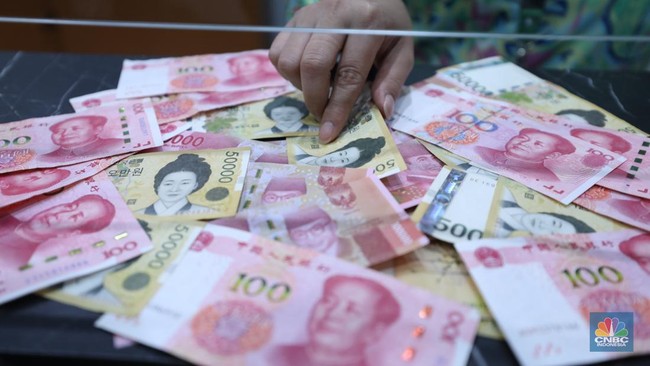
Jakarta, CNBC Indonesia – The start of the week brought a boost for most Asian currencies. A renewed weakening of the US dollar on Monday (26 October 2026) left six of the region’s 10 currencies in positive territory.
The rupiah, however, has yet to benefit from the momentum. Refinitiv data showed that, as of 9.41 am Western Indonesian Time (WIB), the South Korean won was Asia’s strongest performer, rising 0.18% to KRW1,321.21 per US dollar.
The Japanese yen followed, gaining 0.13% to JPY156.65 per US dollar. The Taiwan dollar rose 0.05%, while the Chinese yuan, Singapore dollar and Malaysian ringgit each edged up 0.02%.
At the other end of the scale, the Philippine peso came under the heaviest pressure, weakening 0.33%.
The rupiah followed with a 0.30% fall to Rp18,095 per US dollar, moving further away from the psychological threshold of Rp18,000 per US dollar.
The Thai baht also slipped 0.09%, while the Vietnamese dong eased 0.04%.
The greenback’s pressure eased slightly at the start of the week. The US dollar index (DXY) was down 0.19% at 101.617, as US government bond yields weakened and oil prices fell.
Brent crude dropped by more than 1% to about US$115 a barrel, after briefly reaching a six-month high last week.
The decline followed reports that Qatari mediators were in Tehran on Sunday in an effort to ease regional tensions with the US.
Hopes of a de-escalation reduced some pressure on energy prices. This also restrained the US dollar, which had previously drawn support from high oil prices and inflation concerns.
At the same time, US government bond yields moved lower. The 10-year Treasury yield stood at about 4.974%, while the 30-year yield was at 5.299%; both were near their lowest levels in a month.
“For now, the US bond market appears to be the main driver of the dollar’s broader performance,” Ray Attrill, head of foreign exchange strategy at National Australia Bank, was quoted as saying by Reuters.
Attrill said the fall in Treasury yields had narrowed the yield gap between the US and several other developed economies, reducing some of the US dollar’s appeal.
“I think the market is responding to the decline in Treasury yields that we have seen and the narrowing of the yield gap between the US and the other G10 countries. That has slightly eased the pressure for the US dollar to strengthen,” he said.
Global currency movements this week will be shaped largely by decisions from several major central banks.
The Federal Reserve (Fed), the European Central Bank (ECB) and the Bank of Japan (BOJ) are expected to keep their respective interest rates unchanged.
Meanwhile, markets still see a possibility of rate rises from the Bank of Canada and the Reserve Bank of New Zealand.
As most rate decisions are already anticipated by markets, investors are likely to focus instead on the signals central banks give about the future direction of policy.
“Forward guidance could matter more than the decisions themselves,” Chris Weston, head of research at Pepperstone, was quoted as saying by Reuters.
Weston said this week’s decisions were likely already largely priced in. What could move markets more is how central banks shape expectations for their next meetings.
In the US, market participants are also awaiting several important data releases, including October consumer confidence, the personal consumption expenditures (PCE) price index and jobless claims.
The data will provide further clues about the state of the US economy and the Fed’s policy direction.
With the DXY correcting lower and Treasury yields falling, some Asian currencies have room to strengthen at the start of the week. The South Korean won led gains, while the rupiah and Philippine peso came under the region’s heaviest pressure.
Source: jawawa.id (https://jawawa.id/newsitem/asian-currencies-diverge-won-and-ringgit-surge-while-rupiah-remains-weak-1792986642)
Originally published by CNBC Indonesia (https://www.cnbcindonesia.com/research/20261026094550-128-779356/mata-uang-asia-beda-nasib-won-ringgit-menggila-rupiah-tetap-loyo), translated from Indonesian