
Asian Currencies Diverge Against Dollar: Rupiah and Ringgit Weaken, Yen and Won Strengthen
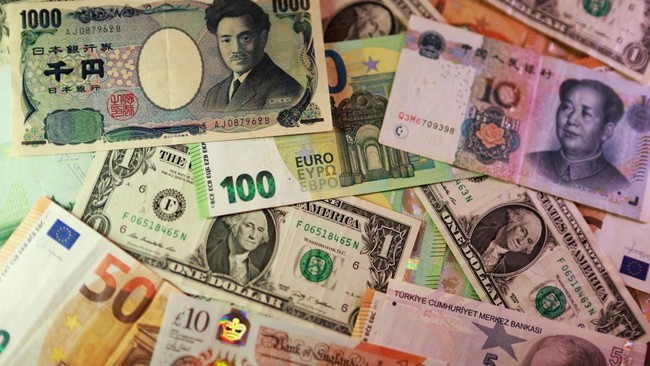
Asian currencies moved unevenly against the United States (US) dollar in the final trading session of the week, Friday (7/8/2026).
According to Refinitiv data as of 09.16 WIB, of 10 Asian currencies, six strengthened against the US dollar, while the other four weakened.
The Japanese yen was the strongest-performing Asian currency this morning, rising 0.28% against the US dollar. The gain came as market attention remained focused on the dynamics of Japanese and US intervention in recent days.
The South Korean won followed with a 0.27% rise to KRW 1,419/US.TheTaiwandollaralsostrengthened0.09, while the Vietnamese dong rose 0.08% to VND 26,214/US$.
The Singapore dollar also gained 0.04%, while the Chinese yuan edged up 0.02%.
On the other side, the Philippine peso suffered the deepest pressure this morning, weakening 0.36% to PHP 60.987/US.TheMalaysianringgitalsoslipped0.07, while the Thai baht edged down 0.03% to THB 33.11/US$.
The rupiah also failed to follow the strengthening of the majority of Asian currencies. The Garuda currency weakened 0.08% to Rp17,925/US.Despitethecorrection, therupiahremainedbelowthepsychologicallevelofRp18, 000/US.
Asian currency movements this morning were still influenced by the dynamics of the US dollar in global markets. The US dollar index (DXY) at the same time was seen edging up 0.03% to 99.956.
The slight rise in the DXY meant Asian currency gains were not uniform. However, the US dollar remained below the 100 level, allowing some regional currencies to stay in positive territory.
Reuters reported that the US dollar moved higher against the yen and the euro on Friday, extending gains from the previous session. Support for the greenback came from growing market doubts about an Iran peace deal, which renewed demand for the US dollar as a safe-haven asset.
The US dollar also received additional impetus from rising US Treasury yields. This followed a Financial Times report citing sources close to Federal Reserve Chair Kevin Warsh suggesting a possible interest rate hike in September, depending on incoming economic data.
In addition, market participants were awaiting the release of US labour market data, namely nonfarm payrolls, on Friday local time. The data will be an important indicator for reading the direction of the central bank’s (The Federal Reserve/The Fed) interest rate policy.
Tensions in the Gulf region also remained in focus. Reuters reported a proposed agreement between Iran and Oman to help end the US-Iran conflict. However, the proposal was said to potentially give Tehran control over inbound traffic through the Strait of Hormuz.
These conditions made the market cautious again. Brent crude oil prices rose more than US$1 to US$83.55 per barrel on Friday, after closing more than US$3 higher in the previous session.
Kristina Clifton, an economist at Commonwealth Bank of Australia, assessed that the US dollar was supported by rising oil prices after the prospects of a US-Iran deal were judged not to be as fast as the market had hoped.
“The US dollar is supported by rising oil prices after news emerged that a deal between the US and Iran to reopen the strait is still further away than expected,” Clifton said, as quoted by Reuters.
Clifton also assessed that the Fed would not rush to raise interest rates, although the possibility of tightening remained open.
“We expect the Fed to wait until December before starting a gradual tightening cycle,” Clifton said.
According to a Reuters survey of economists, US nonfarm payrolls were expected to increase by 80,000 jobs in July, after rising by 57,000 in June. The unemployment rate was expected to remain at 4.2%.
Source: jawawa.id (https://jawawa.id/newsitem/asian-currencies-diverge-against-dollar-rupiah-and-ringgit-weaken-yen-and-won-strengthen-1786074652)
Originally published by CNBC Indonesia (https://www.cnbcindonesia.com/research/20260807092316-128-757317/asia-tak-kompak-hadapi-dolar-rupiah-ringgit-melemah-yen-won-perkasa), translated from Indonesian