
Asian Currencies Collapse: Won and Rupiah Fall, Two Nations Remain Stable
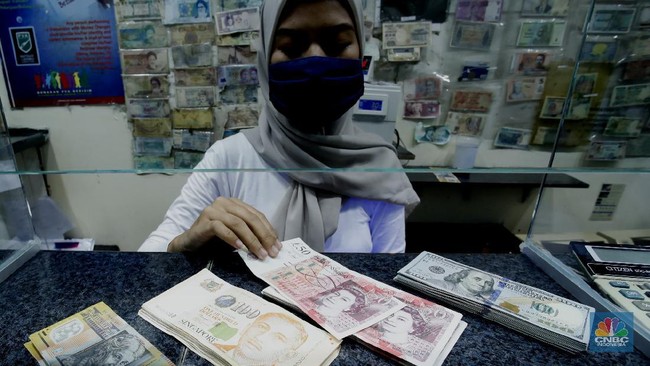
The majority of Asian currencies weakened against the US Dollar during trading on Tuesday (2/6/2026). This pressure occurred as the US Dollar Index (DXY) remained sustained above the 99 level.
According to Refinitiv data as of 09:15 WIB, out of nine Asian currencies, seven weakened against the US Dollar, while two others strengthened. The Rupiah was among the currencies under pressure, declining 0.14% to a position of Rp1,7890/US.ThispositionbringstheRupiahclosertothepsychologicallevelofRp17, 900/US.
The weakening of the Rupiah aligns with most other Asian currencies. The Taiwan Dollar experienced the deepest pressure, falling 0.35% to TWD31.395/US.TheVietnameseDongalsoweakenedby0.26, followed by the South Korean Won, which dropped 0.21% to KRW1,516.4/US$.
The Singapore Dollar corrected by 0.05% to SGD1.287/US, theJapaneseYenweakenedby0.03, while the Philippine Peso fell slightly by 0.01% to PHP61.734/US$.
However, not all Asian currencies were in the red. The Thai Baht strengthened by 0.25% to THB32.57/US, whiletheChineseYuanroseslightlyby0.03.
Meanwhile, the US Dollar Index (DXY) was observed to rise slightly by 0.01% to 99.208 at the same time. Although the strengthening was limited, the DXY remains above the 99 level. The US Dollar continues to receive support from demand for safe-haven assets. This follows reports that peace negotiations between the US and Iran have hit another snag, leading markets to closely monitor inflation risks and the direction of US central bank (The Federal Reserve) interest rates.
On Monday, Iranian media reported that Tehran has suspended communications with Washington in response to Israeli attacks in Lebanon. Conversely, US President Donald Trump stated that talks are still ongoing, adding that a memorandum of understanding with Iran to reopen the Strait of Hormuz could potentially be reached within the next week.
Nevertheless, markets remain cautious as energy-driven inflation rises could prompt the Fed to maintain a tight stance. Market participants have even begun recalculating the possibility of a Fed interest rate hike before the end of the year.
Investors are now awaiting the release of US JOLTS job openings data on Tuesday local time. Following this, market attention will shift to US monthly employment data on Friday, which could provide a clearer picture regarding the direction of Fed interest rate policy. For Asian currencies, the combination of geopolitical uncertainty, energy inflation risks, and US interest rate expectations continues to limit the room for appreciation.