
Asia 'Swallowed' by US Dollar: Rupiah, Won, Yen Weaken; Only Two Currencies Survive
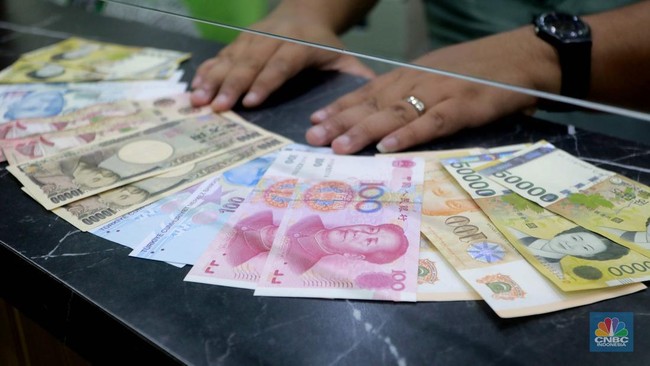
Jakarta, CNBC Indonesia - Pressure returned to Asian currency movements this morning, Wednesday (12/8/2026). The majority of regional currencies weakened against the US dollar, as the greenback held firm ahead of the release of US inflation data.
Referring to Refinitiv data as of 09.14 WIB, of 10 Asian currencies, seven weakened against the greenback. Meanwhile, two currencies strengthened and one remained stagnant.
The South Korean won was the currency with the deepest depreciation in Asia this morning. The won corrected 0.28% to KRW 1,415.05/US$.
The rupiah also entered the red zone. The Garuda currency weakened 0.22% to Rp17,870/US$.
The Philippine peso also weakened 0.16% to PHP 61.326/US, followedbytheSingaporedollarwhichfell0.09.
The Thai baht corrected 0.06% to THB 33.14/US, whiletheJapaneseyenweakenedslightlyby0.04. The Chinese yuan also edged down 0.01%.
On the other hand, the Taiwan dollar was the currency with the highest appreciation in Asia. The Taiwan dollar rose 0.08% to TWD 32.204/US$.
The Vietnamese dong also strengthened slightly by 0.01% to VND26,131/US.TheMalaysianringgitmovedstagnantatMYR4.090/US.
Pressure on the majority of Asian currencies this morning was inseparable from the US dollar which remained strong. The US dollar index (DXY) at 09.10 WIB was observed to have strengthened slightly by 0.03% to 99.861.
Although the increase was limited, market participants remained cautious ahead of the release of US inflation data on Wednesday local time. The data is one of the main agendas this week as it could provide new clues about the direction of the US central bank’s (The Federal Reserve/The Fed) interest rates.
Previously, US labour data that came in weaker than expected was not enough to erase market doubts about the Fed’s next move. This condition has left market participants still waiting for additional confirmation from inflation data.
On the other hand, tensions in the Middle East returned to the spotlight following an attack on a key shipping route. Oil prices rose, with Brent strengthening 0.8% to US$89.61 per barrel.
The rise in oil prices has brought inflation risks back into focus. ING analysts assessed that there is still room for inflation to ease in the remainder of 2026, provided oil prices remain under control and the Strait of Hormuz is reopened.
“There is a path for inflation easing throughout the rest of 2026, assuming oil prices remain contained and the Strait of Hormuz is reopened,” ING analysts wrote, as quoted from Reuters.
However, the Fed’s stance is still not entirely clear. Chicago Fed President Austan Goolsbee said the US central bank is more concerned about inflation that is too high compared to labour market weakness.
Market participants remain divided in reading the Fed’s next move. Fed funds futures are pricing in a 52% chance that the Fed will hold interest rates at the meeting ending 16 September. Meanwhile, the chance of a 25 basis point rate hike stands at 48%, according to the CME Group FedWatch Tool.