
Asia-Pacific Central Bank Governors Gather in Bali: What's on the Agenda?
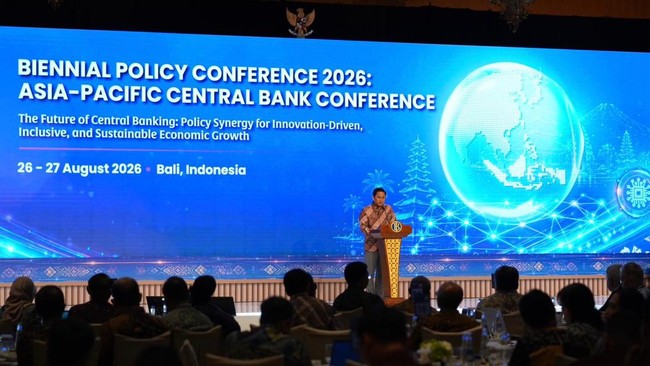
Members of the boards of governors of central banks and financial services authorities in the Asia-Pacific gathered at the Biennial Policy Conference (BPC) in Bali on 26-27 August 2026.
Nobel Economics laureates Prof. Peter Howitt and Prof. Daron Acemoglu were also in attendance.
Also present were Member of the Board of Commissioners of the Financial Services Authority (OJK) Dian Ediana Rae, former Members of the Board of Governors of Bank Indonesia (BI) Miranda S. Goeltom, Halim Alamsyah, and Dody Budi Waluyo, as well as members of the boards of governors of central banks across the Asia-Pacific region.
Deputy Governor of BI Thomas Djiwandono said the conference was held to realise cross-authority and cross-country policy synergy, which plays a crucial role in enabling central banks to maintain macro-financial stability while directing the use of technology for public welfare.
Global changes are becoming increasingly complex due to technological disruption, climate change, and geo-economic fragmentation. Amid these conditions, innovation is the main engine of growth, while economic and financial stability serves as the anchor that allows innovation to grow safely.
“Therefore, cross-authority and cross-country policy synergy is a necessity,” Thomas said at the closing of the BPC in Bali, as quoted on Monday (31/8/2026).
Thomas stressed that stability is a fundamental prerequisite for a country’s progress amid the ongoing “creative destruction” that continues to drive economic dynamics.
Central banks are the primary guardians of macro-financial stability, which allows innovation to develop safely. Therefore, an integrated policy mix must also continue to innovate in response to increasingly non-linear shocks.
“Technology brings efficiency, but efficiency must not be separated from humanity. Inclusivity does not come automatically with technology; it must be designed into it,” Thomas emphasised.
Accordingly, BI is taking an active role in steering the development of the digital ecosystem so that technology remains a means of achieving broader economic benefits.
Furthermore, Thomas said that the multidimensional problems currently faced cannot be solved by central banks acting alone.
“Cross-country collaboration and regional financial safety nets are needed as a shared shield in facing the dynamics of the global financial cycle,” Thomas said.
Meanwhile, Prof. Peter Howitt highlighted two main pathways that drive innovation as an engine of long-term growth.
“First, non-financial factors, namely healthy business competition and intellectual property protection. Second, the role of a strong and stable financial sector in financing a country’s pace of innovation,” Howitt said.
Prof. Howitt further emphasised the strategic role of central banks in maintaining price stability as an anchor for the sustainability of innovation.
“High inflation increases uncertainty and funding costs, while financial shocks can suppress research and development activities that are important for long-term innovation capacity,” he explained.
Therefore, central bank regulation needs to maintain a balance between financial system stability and support for innovation.
This view was reinforced by Prof. Daron Acemoglu, who sees the role of the state as an important factor in determining the benefits of technological progress.
“The direction of technological development, particularly artificial intelligence, will determine whether such progress can strengthen economic stability and public welfare or instead widen inequality,” Acemoglu said.
He stressed that strengthening institutional capacity and governance is an important prerequisite for ensuring that the direction of technological progress can deliver broad benefits to humanity.
A number of strategic issues also emerged during the conference. On the macro-financial policy aspect, strengthening an integrated policy framework is needed to respond to increasingly complex economic changes.
In the field of digital transformation, developments in Central Bank Digital Currency (CBDC), tokenisation, digital assets, and the use of artificial intelligence (AI) are increasingly driving the need for a digital ecosystem that is efficient, interconnected, and resilient.
Meanwhile, the rising risk of climate change has also placed climate risk management and the mobilisation of sustainable financing as an important part of strengthening economic resilience.
These developments reinforce the need for adaptive policies, strong governance, and regional and global synergy to maintain stability and promote inclusive and sustainable growth.
Source: jawawa.id (https://jawawa.id/newsitem/asia-pacific-central-bank-governors-gather-in-bali-whats-on-the-agenda-1788144689)
Originally published by CNBC Indonesia (https://www.cnbcindonesia.com/market/20260831091040-17-763530/dewan-gubernur-bank-sentral-asia-pasifik-kumpul-di-bali-ada-apa), translated from Indonesian