
Asia Not United Against the US Dollar: Baht and Rupee Weaker than the Rupiah!
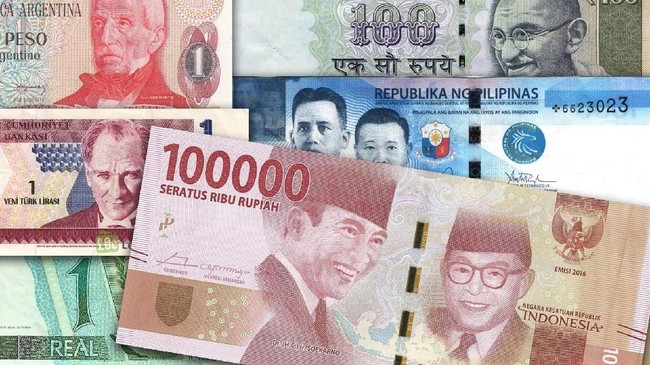
Asian currencies exhibited diverse movements against the US dollar during Wednesday morning’s trading (1/4/2026). The US dollar weakened as safe-haven demand subsided amid fresh signals suggesting a possible de-escalation in the US-Iran conflict.
According to Refinitiv data, as of 10:15 WIB, out of 11 Asian currencies, five strengthened while six weakened against the greenback.
The largest gain was led by the Philippine peso, which rose 0.43% to PHP 60.28/US.TheMalaysianringgitfollowedwitha0.40, while the Chinese yuan climbed 0.23% to CNY 6.88/US$.
Strengthening was also observed in the Taiwan dollar, up 0.18% to TWD 31.88/US, andtheSingaporedollar, whichrose0.06. The Japanese yen remained in positive territory with a slim 0.05% gain to JPY 158.63/US$.
The Thai baht faced the most pressure, weakening 0.40% to THB 32.69/US, followedbytheIndianrupeeandVietnamesedong, bothdown0.18 and VND 26,370/US, respectively.TheSouthKoreanwondeclined0.16.
Meanwhile, the rupiah continued under pressure, weakening 0.15% to Rp17,015/US.Withthisposition, theGarudacurrencyofficiallybreachedthepsychologicalRp17, 000/US level, marking its weakest intraday position ever in the spot market.
This directional movement aligns with the weakening of the US dollar index (DXY). At the same time, the DXY fell 0.17% to 99.793, indicating that the dollar’s strengthening momentum is easing after previously being sought as a safe-haven asset since the conflict erupted at the end of February.
The US dollar had received safe-haven support due to the US and Israel war against Iran triggering a surge in energy prices.
However, this sentiment began to wane after US President Donald Trump stated that US military operations against Iran could end in two to three weeks.
This statement came after a Wall Street Journal report indicated that Trump was even willing to end the military campaign despite the Strait of Hormuz remaining relatively closed, with uncertainty over how that route would be reopened.
Ultimately, the dollar’s morning weakness opened opportunities for some Asian currencies to strengthen. However, due to high uncertainty surrounding the conflict and US policy directions, Asian currency movements remained varied.
Source: jawawa.id (https://jawawa.id/newsitem/asia-not-united-against-the-us-dollar-baht-and-rupee-weaker-than-the-rupiah-1775019118)
Originally published by CNBC Indonesia (https://www.cnbcindonesia.com/research/20260401102309-128-723091/asia-gak-kompak-lawan-dolar-as-bath-rupee-lebih-buruk-dari-rupiah), translated from Indonesian