
Asia in Turmoil: Yen and Rupiah Plummet While Only Korea Remains Resilient
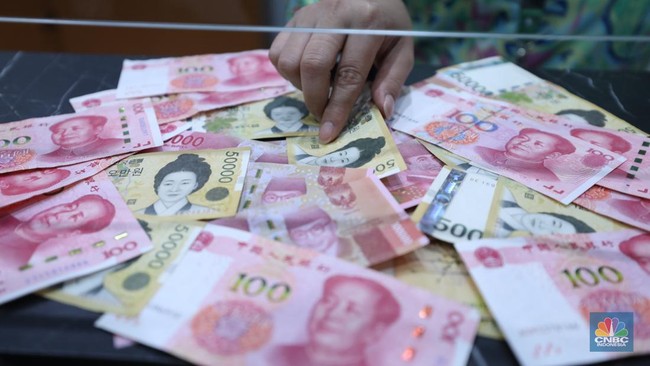
Most Asian currencies experienced a decline against the US Dollar in the latest trading session on Friday (11/09/2026).
According to Refinitiv data as of 09:20 WIB, nine out of ten Asian currencies weakened against the US Dollar, with only one currency managing to strengthen. The Japanese Yen faced the deepest pressure in Asia this morning, weakening by 0.57% to JPY 154.47/US$.
The Indonesian Rupiah followed as the next deepest decliner, with the Garuda currency dropping 0.37% to Rp17,595/US.TheMalaysianRinggitalsocorrectedby0.27, followed by the Philippine Peso, which fell 0.19% to PHP 62.707/US$.
Furthermore, the Chinese Yuan weakened by 0.11% to CNY 6.7132/US, theThaiBahtdropped0.09, the Taiwan Dollar weakened by 0.07% to TWD 31.618/US, theSingaporeDollarcorrectedby0.02, and the Vietnamese Dong fell slightly by 0.01% to VND 25,924/US$.
On the other hand, the South Korean Won was the only Asian currency to strengthen this morning, rising 0.17% to KRW 1,347.1/US$.
The movement of Asian currencies this morning is driven by the strengthening of the US Dollar Index (DXY), which was observed to rise by 0.05% to 99.102 at 09:22. This morning’s DXY strength continues a 0.23% increase from the previous trading session.
The US Dollar is receiving renewed support from increased demand for safe-haven assets. This sentiment emerged as concerns over energy supply disruptions in the Middle East resurfaced, driving oil prices higher. Brent crude prices rose 1.2% to US$108.96 per barrel at the start of Asian trading, continuing a six-day upward trend in energy prices.
The rise in oil prices has led markets to reassess inflation risks. This is critical as rising inflation could strengthen the possibility of the US Federal Reserve (The Fed) raising interest rates at its meeting next week.
“The US Dollar safe-haven is strengthening due to capital flows into safe assets, aided by rising energy prices which have pushed the probability of a Fed rate hike next week to 70%,” said Tony Sycamore, a market analyst at IG in Sydney, as quoted by Reuters.
Markets are now awaiting the release of US Consumer Price Index (CPI) data on Friday local time. This data serves as one of the final key indicators before the Fed holds its policy meeting on 15-16 September 2026. According to CME FedWatch, market participants are now pricing in a 71.3% chance that the Fed will raise interest rates by 25 basis points at next week’s meeting, up from 61.2% in the previous session.
Previously, US Producer Price Index (PPI) data for August rose by 0.4%, meeting market expectations, alongside rising energy prices during that month.
Pressure is also coming from the bond market. The 10-year US Treasury yield rose by 2.3 basis points to 4.965%, approaching the 5% level. This rise in yields makes US Dollar-denomised assets more attractive to investors.
At the same time, the bond market remains unsettled after the US Treasury Department tripled the size of its long-term bond buyback operations. The US Treasury Department will purchase up to US$6 billion in long-term bonds on Thursday local time.