
Asia in Turmoil: Rupiah, Yen, Yuan, and Ringgit All Decline
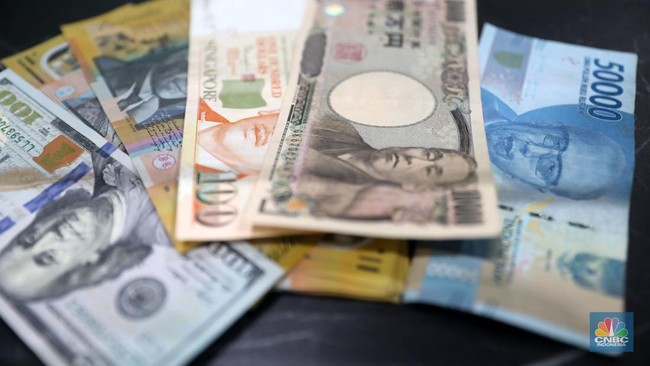
Pressure has once again enveloped Asian foreign exchange markets during trading on Tuesday (6/10/2026). All monitored regional currencies moved weaker against the US Dollar, even though the US Dollar Index remained relatively stagnant this morning.
According to Refinitiv data as of 09:15 WIB, all nine monitored Asian currencies were in the red zone. The Philippine Peso recorded the deepest decline with a depreciation of 0.30% to PHP62.746/US.TheSouthKoreanWonfollowedwithacorrectionof0.16.
The Indonesian Rupiah also weakened by 0.06% to the level of Rp17,905/US, whiletheSingaporeDollardepreciatedby0.05. The Vietnamese Dong fell by 0.04% to VND26,001/US$.
The Taiwan Dollar and Thai Baht each weakened by 0.03% to TWD31.72/US$ and THB33.65/US$ respectively. The Japanese Yen corrected by 0.02% to JPY157.94/US, whiletheMalaysianRinggitrecordedthesmallestdeclineof0.01.
Amid the simultaneous weakening of Asian currencies, the US Dollar Index (DXY) was observed to be stagnant at the 102.159 level at 09:15 WIB. Although movement was limited this morning, the dollar remains at a high level following a strong rally in recent sessions. Quoting Reuters, the DXY previously touched its highest level in 18 months.
The strength of the greenback is still supported by high US Treasury yields, which reached their highest levels in decades during the previous trading session. This condition maintains the attractiveness of dollar-based assets, even though expectations for a Federal Reserve interest rate hike in October have begun to subside following weaker-than-expected US labour market data.
Pressure on the Euro also supports the Dollar. The European single currency moved around US$1.1220, near its lowest level in 17 months, after being pressured by concerns over high debt levels and political deadlock in France. The announcement of an early election in Spain has also added uncertainty to the Eurozone.
“For the Euro to strengthen, a significant drop in oil prices, a sharp increase in expectations for European monetary policy tightening, or improvements in budget deficit control are required,” said Joseph Capurso, a strategist at Commonwealth Bank of Australia, as quoted by Reuters.
On the other hand, the strength of the Dollar remains resilient even as markets begin to reduce expectations for a Fed rate hike this month. Investors still assess that the US central bank may need to maintain tight policy for longer because inflationary pressures have not yet fully subsided.
Data on Monday showed that US service sector activity slowed in September. However, persistently strong domestic demand continues to strain supply chains and drive up business input prices, adding to concerns that inflation could remain high into next year.