
Asia in Turmoil: Ringgit, Won, and Rupiah All Decline
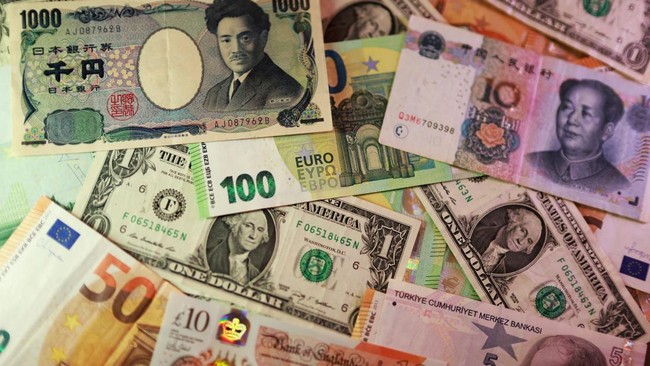
Asian currencies are once again under pressure from the US Dollar in this morning’s trading. The strengthening greenback has pushed the majority of Asian currencies into the red.
According to Refinitiv data on Tuesday (1/9/2026) at 09:16 WIB, seven out of nine Asian currencies weakened against the US Dollar, while two managed to gain ground.
The Malaysian Ringgit faced the deepest pressure in Asia this morning, weakening 0.30% to MYR 4.034/US.SouthKorea′sWonfollowedwitha0.24, and the Thai Baht also corrected by 0.12% to THB 33.18/US$.
The Indonesian Rupiah also moved lower, with the Garuda currency dropping 0.06% to Rp17,720/US.TheSingaporeDollarweakenedby0.05, followed by the Japanese Yen, which fell 0.03% to JPY 159.79/US.TheChineseYuanalsosawaslightcorrectionof0.01.
On the other hand, the Taiwan Dollar was the strongest performer in Asia, gaining 0.25% to TWD 31.613/US.ThePhilippinePesoalsomovedpositively, strengthening0.12.
The decline in most Asian currencies occurred as the US Dollar strengthened. The US Dollar Index (DXY) was observed to rise 0.08% to 99.503 at the same time.
This rise in the DXY follows a period where the US Dollar had weakened; the index previously dropped 0.24% to 99.43 after hitting 99.73 last Friday, its strongest level since 17 August.
Markets are currently closely monitoring the direction of US central bank (The Federal Reserve) interest rates following remarks by Fed Chair Kevin Warsh at Jackson Hole, which were perceived as hawkish. Warsh stated that the US central bank still has work to do if policymakers are not confident that inflation is moving towards the 2% target.
These comments have caused expectations for a Fed rate hike to rise again. Fed funds futures are now pricing in a 64% chance of a rate hike in September, up from approximately 35% before Warsh’s comments on Friday.
Elwin de Groot, head of macro strategy at Rabobank, assessed that Warsh’s statements were indeed aimed at raising rate hike expectations. “Warsh’s written statement appears designed to raise interest rate hike expectations, shifting the September debate towards the hawkish camp and rebuilding his credibility in fighting inflation,” de Groot said, as quoted by Reuters.
Additionally, markets are awaiting US labour market data this week. The August employment report, due this Friday, is expected to show an addition of 55,000 jobs. This data will serve as a crucial indicator before the Fed holds its meeting on 15-16 September.
Marc Chandler, chief market strategist at Bannockburn Global Forex, believes the labour data will be decisive for the Fed’s room for manoeuvre. “If we see a direct decline in jobs, I don’t see how the Fed can raise interest rates. I don’t think they ever raise rates after the economy has lost jobs for two consecutive periods,” Chandler said, as quoted by Reuters.
Pressure on Asian markets also stems from rising global bond yields. Expectations of higher interest rates, fiscal concerns, and rising oil prices have led markets to adopt a cautious stance.