
Asia Hit by US Dollar: Japanese Yen and Chinese Yuan Slide, Rupiah Strengthens
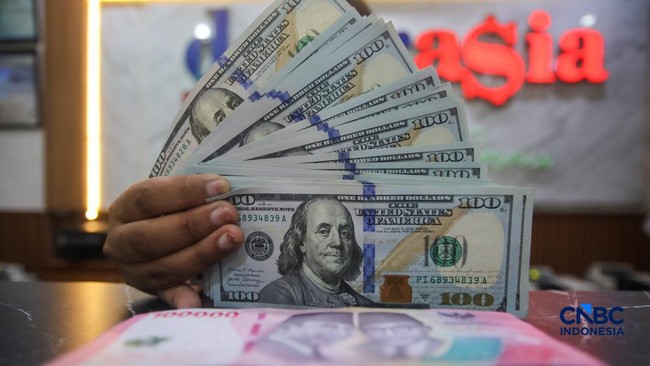
Sabang, CNBC Indonesia — Most Asian currencies weakened against the US dollar this week. Although the US dollar remained under pressure, most currencies in the region were unable to make gains.
Refinitiv data showed that five of the nine Asian currencies monitored fell against the US dollar, while four strengthened.
The Taiwanese dollar came under the heaviest pressure this week, falling 0.61% to TWD32.803 per US dollar.
The Japanese yen followed, weakening 0.6% to JPY158.47, while the Singapore dollar fell 0.43% and the Chinese yuan declined 0.33%. The Malaysian ringgit edged down 0.05%.
Amid the pressure on most Asian currencies, the South Korean won was the strongest performer, rising 2.24% to KRW1,363.35 per US dollar.
The Philippine peso also strengthened, gaining 1% to PHP63.009 per US dollar, while the Thai baht rose 0.56%. The rupiah also performed positively, gaining 0.22% to Rp18,080 per US dollar.
Asian currencies’ movements this week came as the US dollar index (DXY) advanced 0.4% over the week to 102.291.
The US dollar index surged on Friday (6 November 2026), rising 0.73% in a single day — its biggest daily percentage gain in nearly five months — after a stronger-than-expected US payrolls report bolstered expectations of a Federal Reserve rate rise next month.
The US Department of Labour said non-farm payrolls jumped by 165,000 last month, exceeding the 65,000 forecast by economists polled by Reuters, following an upward revision to 60,000 in September. The unemployment rate fell to 4.1%.
Expectations of a Fed rate rise next month had fallen to about 67% on Thursday as US equities plunged, with the S&P 500 shedding around US$3 trillion in market value. The Nasdaq recorded its biggest one-day percentage decline in 19 months amid concerns that tighter government regulation of AI development following the US midterm elections would hamper economic growth.
Lawmakers, congressional staff and advocates said Democrats planned to introduce a series of new bills targeting artificial intelligence systems and data centre development when they take control of the US Congress in January.
The US dollar strengthened ahead of the jobs data, supported by demand for safe-haven assets as a sell-off in AI stocks spread around the world. US shares had nevertheless stabilised by the market opening, and the Nasdaq was up more than 1% towards the end of the trading day.
US Treasury yields rose after the jobs report. The 10-year Treasury yield climbed 1.6 basis points to 4.85%, while the two-year yield rose 4.1 basis points to 4.52%.
“This is the same old conversation: at any given moment, is the dollar trading more on safe-haven principles or on interest-rate differentials? Sometimes it is one or the other, and they can be completely at odds with each other — which is not really rational,” Eugene Epstein, head of trading and structured products at Moneycorp in Stamford, Connecticut, said, according to Refinitiv on Saturday (7 November 2026).
“Now that things are starting to calm down a little, the market is digesting the new normal for the next two years. I think correlations should start to become a little more rational going forward.”
Comments from Fed officials on Friday also supported the case for raising interest rates. New York Fed President John Williams said US economic growth remained highly resilient in the face of successive shocks, but inflation was too high and it was essential to bring it back to 2%.
Separately, St Louis Fed President Alberto Musalem said inflation remained a primary concern in his conversations with businesses in his Midwest district. San Francisco Fed President Mary Daly said the Fed might still need to raise rates further despite the “painful” sell-off in technology shares.
Source: jawawa.id (https://jawawa.id/newsitem/asia-hit-by-us-dollar-japanese-yen-and-chinese-yuan-slide-rupiah-strengthens-1794023432)
Originally published by CNBC Indonesia (https://www.cnbcindonesia.com/research/20261107042351-128-783136/asia-dipukul-dolar-as-yen-jepang-yuan-china-ambruk-rupiah-perkasa), translated from Indonesian