
Asia Grassroots Forum: Financial Health Becomes New Frontier for Grassroots Financial Inclusion
Progress in financial inclusion over the last decade has opened wider access for the public to formal financial services. Based on the 2025 National Survey of Financial Literacy and Inclusion (SNLIK) conducted by the OJK and BPS, Indonesia’s financial inclusion index has reached 80.51 per cent, while the financial literacy index stands at 66.46 per cent. Globally, the World Bank Global Findex Database 2025 notes that 79 per cent of adults have a financial account, yet only 56 per cent possess emergency funds to face unexpected circumstances.
These findings indicate that the expansion of financial access must be accompanied by the strengthening of financial health so that financial services can help the public manage income, face risks, and build long-term prosperity. As the digital financial ecosystem evolves, the attention of industry players, regulators, and international organisations is shifting from merely expanding access towards efforts to build the financial resilience of the community.
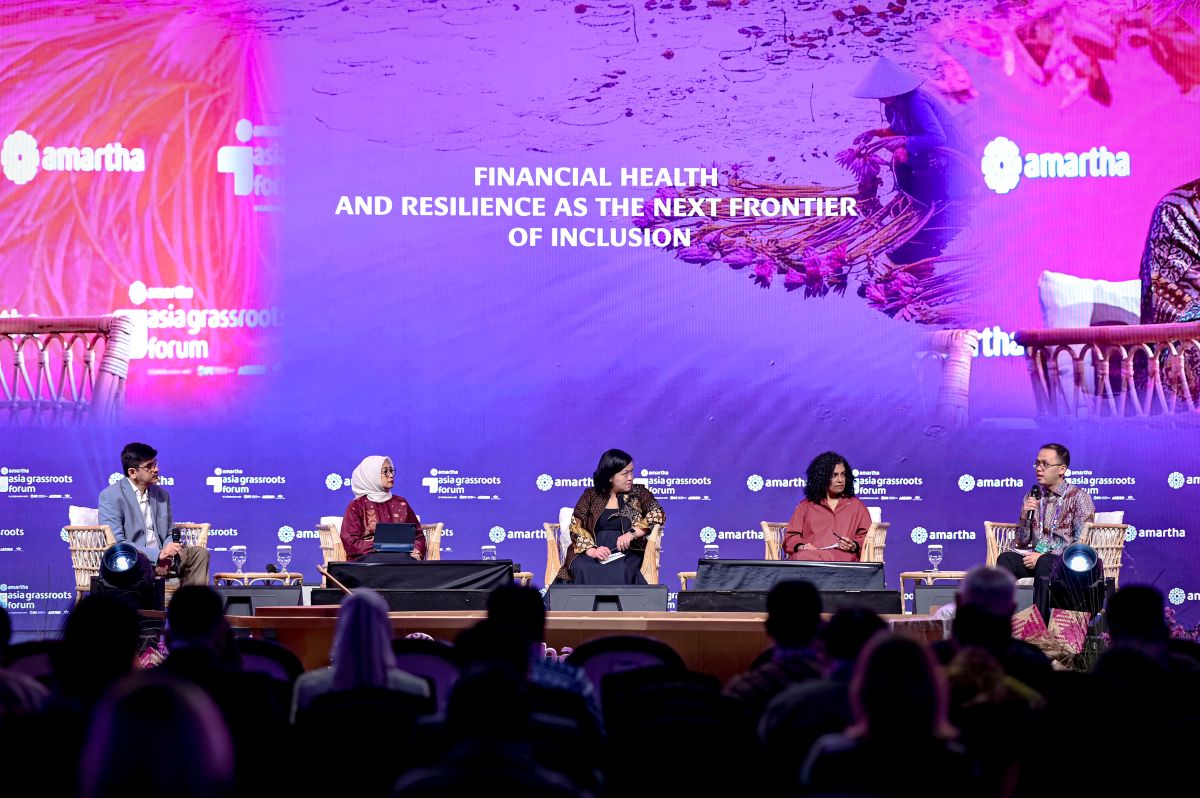
This shift in focus was one of the discussion topics in the panel titled ‘Financial Health and Resilience: The Next Frontier of Inclusion’ at The 2026 Asia Grassroots Forum, an annual forum initiated by Amartha Financial to bring together policymakers, industry players, investors, and international organisations to discuss various opportunities and challenges for inclusive economic growth.
The 2025 visit of H.M. Queen Máxima of the Netherlands to Indonesia serves as an example of how efforts to strengthen financial health must begin with an understanding of the needs of the grassroots community. The visit began with direct meetings with entrepreneurs and communities on the ground before proceeding to dialogues with industry players and the government.
According to Nancy Widjability, Policy Advisor at the Office of the United Nations Secretary-General’s Special Advocate for Financial Health (UNSGSA) for H.M. Queen Máxima of the Netherlands, the advocacy process at both national and global levels must be built on a deep understanding of community needs and supported by credible data.
“Ultimately, it all comes back to the grassroots. Understanding their needs is the first step in designing policies, products, and collaborations that are truly relevant,” said Nancy.
She added that data and credibility are essential elements in driving change. By understanding the challenges faced by people on the ground, stakeholders can provide financial solutions that not only expand access but also help improve the quality of life for the community sustainably.
The Head of the Department of Inclusive and Green Financial Economics at Bank Indonesia (BI), Anastuty Kusumowardhani, stated that strengthening financial health is also a vital part of building more productive and competitive MSMEs. In addition to expanding access to financing, Bank Indonesia continues to strengthen empowerment, market access, as well as education and risk mitigation for business actors.
According to Anastuty, the next challenge lies not only in access to financing or markets but also in strengthening the mindset of business actors. The ability to maintain quality, meet market standards, and consistently respond to buyer needs are crucial factors in increasing the competitiveness of Indonesian MSMEs.
Amartha has experienced similar challenges over more than 16 years of assisting women MSME entrepreneurs in various regions of Indonesia. Currently, Amartha reaches nearly 4 million women entrepreneurs through more than 9,000 field officers who also support the adoption of digital services and the strengthening of business capacity in rural communities.
Based on these learnings, Amartha continues to develop services designed alongside women through a ‘design with women’ approach, ensuring that the solutions provided are increasingly relevant to their evolving needs, experiences, and financial goals.
“During more than 16 years of assisting women MSME entrepreneurs in Indonesia, we have learned that every woman has different financial goals and journeys. Therefore, we believe the most relevant solutions are born from listening to their needs and designing them together with them,” said Amartha’s Chief Compliance and Sustainability Officer, Aria Widyanto.
According to Aria, field experience shows that economic empowerment is a process built through various complementary aspects, ranging from financial access, literacy, and the use of technology to support from a wider ecosystem.
As access to financial services becomes more widespread, the focus of stakeholders is shifting towards how this access can be translated into sustainable financial resilience and prosperity for the community. To achieve this, collaboration is required between regulators, industry players, investors, and international organisations so that the benefits of financial inclusion can be felt more broadly by the grassroots community.
Source: jawawa.id (https://jawawa.id/newsitem/asia-grassroots-forum-financial-health-becomes-new-frontier-for-grassroots-financial-inclusion-1782211826)
Originally published by Media Indonesia (https://mediaindonesia.com/ekonomi/903454/lewat-asia-grassroots-forum-kesehatan-finansial-jadi-babak-baru-inklusi-keuangan-bagi-akar-rumput), translated from Indonesian