
Asia Divided: Rupiah Strengthens While Ringgit, Yen, and Singapore Dollar Slump
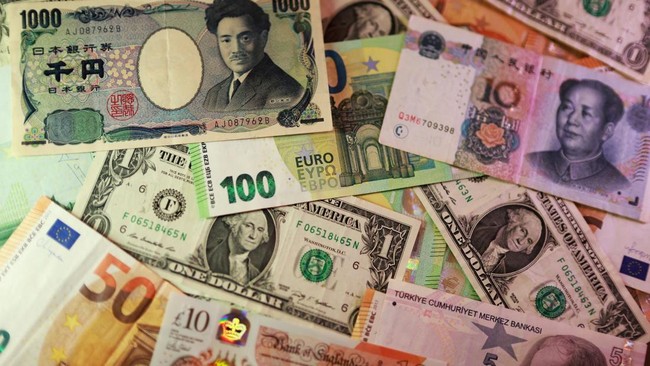
Asian currencies showed mixed performance against the US Dollar during trading on Friday (31/07/2026). Notably, the Indonesian Rupiah managed to strengthen even as most regional currencies entered the red zone.
According to Refinitiv data as of 09:18 WIB, six Asian currencies were observed weakening against the greenback, while four exchange rates managed to appreciate. The Rupiah was among the strengthening Asian currencies this morning, rising 0.14% to a position of Rp18,050/US$.
However, the largest gains this morning were recorded by the Philippine Peso, which appreciated 0.21% to PHP 61.337/US.TheVietnameseDongalsostrengthenedby0.10, followed by the Chinese Yuan, which rose 0.09% to CNY 6.7487/US$.
Conversely, the Japanese Yen experienced the deepest decline in Asia, weakening 0.66% to JPY 160.57/US, reversingasharp2.37.
The Malaysian Ringgit weakened by 0.25%, while the Singapore Dollar fell by 0.23%. The Taiwan Dollar corrected by 0.13%, and the Thai Baht saw a slight decline of 0.03%.
The depreciation of most Asian currencies today occurred amidst dynamics of a rebounding US Dollar during morning trading. The US Dollar Index (DXY) was observed rising 0.30% to a position of 100.171. This rise in the DXY follows a period where the US Dollar closed sharply lower by 1.01% in the previous session, dropping below the 100 level to 99.9. Consequently, this morning’s movement reflects an attempt by the US Dollar to recover after being heavily pressured the day before.
The US Dollar had previously weakened broadly after the Federal Reserve (The Fed) maintained its benchmark interest rate. This decision raised market questions regarding the strength of the US central bank’s commitment to bringing inflation back to its 2% target.
The Fed maintained interest rates within the 3.50%-3.75% range. However, the decision was not entirely unanimous, as three of the twelve Federal Open Market Committee (FOMC) members opted for a 25 basis point rate hike during the meeting.
“So far, this decision is very negative for the dollar, but in previous meetings, the initial reaction could be mistaken,” said Juan Perez, director of trading at Monex USA, as quoted by Reuters.
Pressure on the US Dollar also stemmed from the strengthening of the Japanese Yen following speculation regarding currency intervention by Japanese authorities. The potential for intervention in Tokyo helped bolster the Yen and weigh on the US Dollar following the Fed’s decision.
Nevertheless, the pressure on the US Dollar has not entirely eliminated the possibility of further gains. Sebastien Mc Mahon, chief economist at iA Financial Group, noted that the US bond market is signalling that the Fed is perceived to be lagging in controlling inflation.
“The market has already priced in some of the tightening that the Fed is reluctant to undertake,” said Mc Mahon, as quoted by Reuters.
This situation leaves the direction of the US Dollar uncertain. On one hand, the Fed’s decision to hold interest rates initially pressured the greenback. On the other hand, differing views within the Fed and inflation concerns mean the possibility of policy tightening has not been entirely ruled out.