
Asia Divided Against the US Dollar: Yen Gains, Rupiah and Won Slump
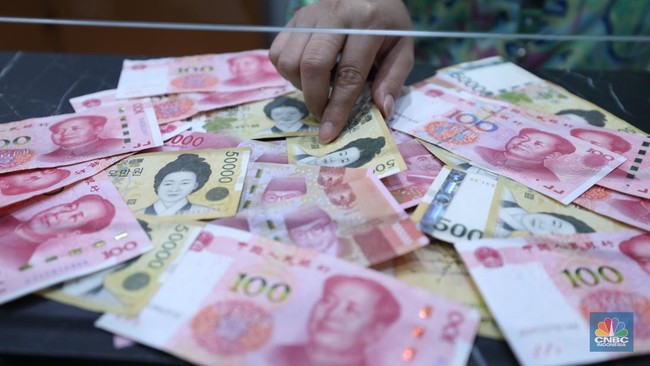
Asian currencies moved in different directions against the US dollar in early trading on Thursday, 15 October 2026.
Refinitiv data at 9.25 am Western Indonesian Time showed that six of the 10 Asian currencies monitored had strengthened against the dollar, while four had weakened.
The Japanese yen posted the sharpest gain of the morning, rising 0.37% to JPY157.73 per US dollar.
The Singapore dollar followed, gaining 0.22%, while the Thai baht strengthened 0.12%. The Vietnamese dong rose 0.04%, the Malaysian ringgit 0.02%, and the Chinese yuan edged up 0.01%.
At the other end of the scale, the South Korean won came under the heaviest pressure, falling 0.92% to KRW1,350.73 per US dollar.
The Taiwan dollar weakened 0.44%, followed by the Philippine peso, which fell 0.41%.
The rupiah was also unable to benefit from the weaker US dollar. Indonesia’s currency slipped 0.27% to Rp17,943 per US dollar.
The US dollar lost considerable ground in morning trading. The US Dollar Index (DXY) was down 0.58% at 101.960.
The decline came after the greenback had briefly reached an 18-month high. Notably, the dollar fell even though US inflation data released overnight came in higher than expected.
US core inflation rose 0.3% month on month in September, above economists’ forecast of 0.2%. Year on year, core inflation reached 2.6%, also exceeding the 2.5% forecast.
Headline US inflation rose to 3.7% year on year, higher than the expected 3.6%.
The data briefly led markets to raise the probability of a Federal Reserve rate increase in October to around 50%.
However, that sentiment did not last. Several Fed officials struck a more cautious tone, saying the central bank could wait for further data before raising rates again.
“Although the overall inflation figures were slightly higher than expected, the market appears to believe that the data are not hot enough to force the Fed to raise rates in October,” said Khoon Goh, head of Asia research at ANZ, as quoted by Reuters.
Those comments reduced expectations of an October rate rise and added to pressure on the US dollar.
The dollar also lost support from the bond market. The yield on 10-year US government bonds fell to 5.1267%, its lowest level in three weeks. The 30-year yield stood at around 5.4795%.
Falling yields slightly reduced the appeal of dollar-denominated assets.
“The US dollar’s gains are losing momentum as the decline in Treasury yields, after their initial surge, takes away some of the support from the interest-rate side,” said Sim Moh Siong, a foreign-exchange strategist at OCBC.
Markets will next turn to US producer-price and retail-sales data, due on Thursday local time. The figures will provide further clues about price pressures and consumer conditions ahead of the Fed’s meeting on 27–28 October.
Source: jawawa.id (https://jawawa.id/newsitem/asia-divided-against-the-us-dollar-yen-gains-rupiah-and-won-slump-1792036226)
Originally published by CNBC Indonesia (https://www.cnbcindonesia.com/research/20261015091144-128-776357/asia-tak-kompak-lawan-dolar-as-yen-menguat-rupiah-won-tersungkur), translated from Indonesian