
Asia Divided Against Dollar: Rupiah and Ringgit Slump, Won and Yen Strengthen
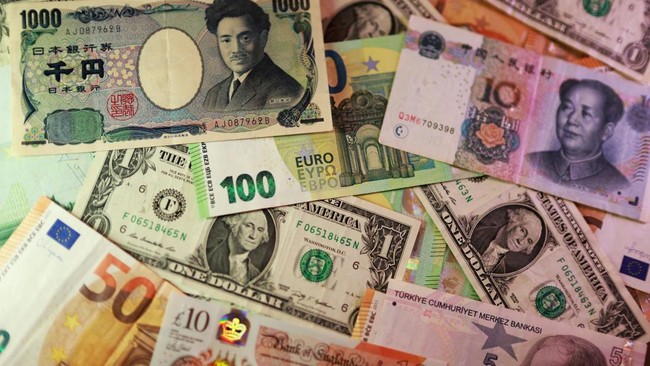
The movement of Asian currencies against the US dollar was mixed on Thursday (18/6/2026) trading. Pressure returned after the results of the Federal Open Market Committee (FOMC) meeting indicated the US central bank (The Fed) is becoming more hawkish. According to Refinitiv data as of 09.25 WIB, five out of ten Asian currencies weakened against the dollar, while five strengthened. The heaviest pressure fell on the rupiah. The Garuda currency weakened 0.73% to Rp17,860/US, makingitthecurrencywiththedeepestcorrectioninAsia.ThispositionsawtherupiahbreachtheRp17, 800/US level again. Below the rupiah, the Malaysian ringgit also came under significant pressure, falling 0.49% to MYR 4.085/US.ThePhilippinepesoalsoenteredtheredzoneaftercorrecting0.23. The Vietnamese dong also weakened, falling 0.21% to VND 26,319/US.Meanwhile, pressureontheChineseyuanwasmorelimited, withacorrectionof0.08. However, not all Asian currencies weakened. The South Korean won was the strongest this morning, strengthening 0.22% to KRW 1,523.82/US.TheTaiwandollaralsomovedpositively, rising0.20. More modest gains were seen in the Singapore dollar, which rose 0.10% to SGD 1.286/US, followedbytheThaibaht, whichstrengthened0.09. The Japanese yen also held in the green zone, albeit with a slight gain of 0.01% to JPY 160.62/US$. Meanwhile, the US dollar index (DXY) was observed strengthening 0.21% to 100.299 at the same time. This gain extended pressure from the previous trading session. On Wednesday (17/6/2026), the DXY closed 0.55% higher after the FOMC results signalled The Fed still has the potential to raise interest rates. The Fed indeed maintained its benchmark interest rate at the meeting on Wednesday local time. However, the US central bank’s stance appeared more hawkish as policymakers began to see the possibility of a Fed Fund Rate hike this year. The latest quarterly projections showed nine Fed officials now anticipate an interest rate increase by the end of 2026. In addition, the latest policy statement removed language that had previously signalled the possibility of further rate cuts in 2026. This stance emerged as US economic data continues to show fairly strong conditions. The US labour market remains solid, the unemployment rate held low at 4.3%, while inflation is still far above The Fed’s 2% target. The new Fed Chair, Kevin Warsh, in his inaugural press conference, also touched on changes in the central bank’s communication methods with the public, including regarding the dot plot or interest rate projections of Fed officials. Warsh said the projections are written in pencil with a large eraser. He added that policymakers do not feel fully bound by their respective projections. The Fed’s more hawkish signal caused US bond yields to rise, especially the two-year tenor which briefly touched its highest level in more than a year. This condition further strengthened the US dollar and pressured the movement of other countries’ currencies, including those in Asia.