
Asia Bows to Dollar: Rupiah, Won, Ringgit Tumble, Only Yen Survives
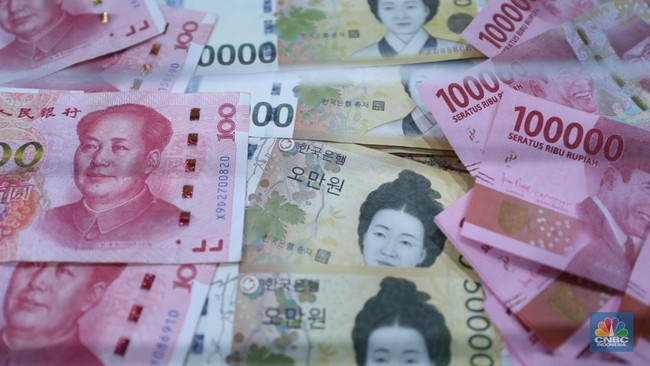
Jakarta, CNBC Indonesia - The majority of Asian currencies weakened against the United States (US) dollar in trading on Friday (19/6/2026). The pressure came as the US dollar remained at a high level after soaring in the previous session.
Referring to Refinitiv data as of 09.15 Western Indonesia Time (WIB), eight out of nine Asian currencies were under pressure from the US dollar, while only one currency strengthened.
The rupiah was the currency under the deepest pressure in Asia this morning. The Garuda currency weakened 0.68% to a position of Rp17,820/US, adepreciationthatpushedtherupiahfurtherawayfromtheRp17, 700/US level.
Pressure was also seen on the Vietnamese dong, which weakened 0.25% to VND26,335/US.TheThaibahtandthePhilippinepesobothfell0.18 and PHP60.652/US$, respectively.
The Taiwan dollar also weakened 0.12% to TWD31.649/US, followedbytheSingaporedollarwhichcorrected0.11. The Malaysian ringgit also entered the red zone after weakening 0.07% to MYR4.118/US, whiletheSouthKoreanwonedgeddown0.04.
Amid the pressure on the majority of Asian currencies, the Japanese yen was the only currency able to strengthen. The yen rose 0.11% to JPY161.2/US$.
Meanwhile, the US dollar index (DXY) was observed to be relatively stable with a slight gain of 0.01% to 100.859 at the same time.
Although it only edged up this morning, the US dollar’s position remained strong after the DXY surged 0.76% in trading on Thursday (18/6/2026). That strengthening brought the US dollar index to its highest level in the last 12 months.
The US dollar continued to draw strength from the results of the Federal Open Market Committee (FOMC) meeting on Wednesday US time. The US central bank (The Federal Reserve/The Fed) did hold its benchmark interest rate, but the policy tone conveyed tended to be hawkish.
The market is still digesting the latest signals from The Fed under the leadership of new Chair Kevin Warsh. Warsh’s relatively firm comments, coupled with The Fed’s latest official projections regarding the direction of interest rates, have led market participants to increase expectations for a rate hike this year.
Fed funds futures show market participants now pricing in an 86.4% probability that The Fed will raise interest rates at least once this year. That figure is up from 80.5% the previous day and much higher than the 57.1% seen a week ago.
The strengthening of the US dollar was also supported by the widening perception of interest rate differentials between the US and other major countries. When US yields and rate expectations rise, the US dollar becomes more attractive to global investors.
“So, there is an increase in the interest rate differential between the US and the rest of the world,” said Jeff Klingelhofer, managing director and portfolio manager at Aristotle Pacific Capital.
However, some market participants assess that the room for further US dollar strengthening from current levels may be starting to become limited. The decline in oil prices after the US and Iran signed a preliminary agreement to end the war could ease inflationary pressures.
“We judge the bar for further dollar gains from here to be quite high,” wrote Matthew Ryan, head of market strategy at Ebury, as quoted by MarketWatch.
Ryan assessed that the increasingly imminent signing of an Iran peace framework could cause oil prices to continue weakening. This has the potential to reduce US inflationary pressures and curb the chances of a rate hike in the second half of this year.