
ASI Survey: Public Trust in the President Reaches 61.4 Per Cent
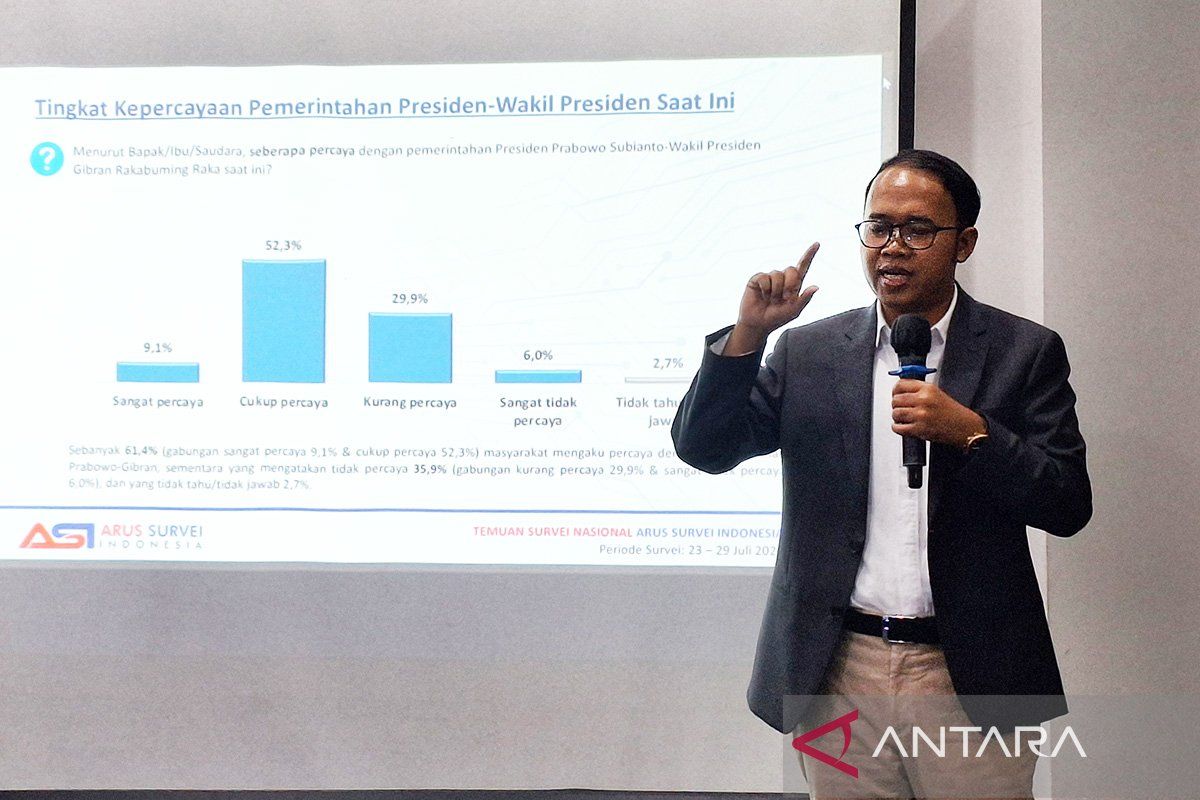
Jakarta (ANTARA) - Arus Survei Indonesia (ASI) reported that the majority of the public still has confidence in the administration of President Prabowo Subianto and Vice President Gibran Rakabuming Raka.
Public trust in the Prabowo-Gibran administration is assessed as fairly positive, at around 61.4 per cent, whilst 35.9 per cent said they did not trust it and 2.7 per cent said they did not know or gave no answer.
“The level of trust relates to things that are, so to speak, intangible — things that cannot be seen. This is about belief,” said Ali Rif’an, Executive Director of Arus Survei Indonesia, in his statement in Jakarta on Monday.
Ali said that statistically, the results of the national survey remain at the threshold of a majority.
“It is still relatively positive,” he said.
Regarding satisfaction with President Prabowo Subianto’s performance, 57.6 per cent of the public said they were satisfied, whilst 40.6 per cent said they were dissatisfied and 1.8 per cent did not know or gave no answer.
The survey release by Arus Survei Indonesia forms part of a national research study themed “Evaluation of the Performance & Priority Programmes of the Prabowo-Gibran Administration.”
The survey was carried out from 23 to 29 July 2026 nationwide across 38 provinces in Indonesia through face-to-face interviews. It used a sample of 1,200 respondents, drawn using multistage random sampling, with a margin of error (MoE) of ±2.9 per cent at a 95 per cent confidence level.
The survey also stated that the majority of the public still wants the Free Nutritious Meal (MBG) programme to continue, as it is one of the priority programmes of the administration of President Prabowo Subianto and Vice President Gibran Rakabuming Raka.
This was reflected in the national survey results, with 51.5 per cent of the public agreeing that the MBG programme should continue (a combination of 12.3 per cent strongly agreeing and 39.3 per cent somewhat agreeing).
Meanwhile, 45.4 per cent of respondents said they did not agree with continuing the programme. That figure combines 29.6 per cent who were somewhat dissatisfied and 15.8 per cent who were strongly dissatisfied. Only 3.3 per cent of respondents said they did not know or gave no answer.
According to Ali, the findings show that the MBG programme is still seen as relevant to the needs of the public.
Ali assessed that public support for the continuation of a government programme is ultimately strongly influenced by how the programme is implemented and directly experienced by the public.