
Ash Falls, Voices Scatter
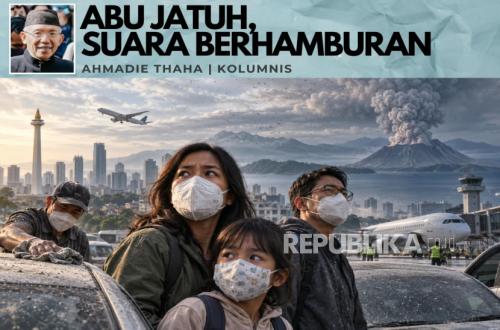
That morning, Jakarta looked as though it had been dusted with flour from a botched recipe. Cars had gone dull, bus-stop floors were dusty, and window panes held a thin grey layer. People looked up at the sky, some searching for clouds, others searching for answers.
On phone screens, the same images moved from one WhatsApp group to another: layers of dust on vehicle surfaces, rooftops, main roads, and the faces of residents beginning to don masks. The difference from ordinary rain was that this time, what fell from the sky was ash.
As is typical of unusual events, what came down was not only volcanic particles but also a cascade of advice, warnings, clarifications, instructions, short videos, comments, jokes, panic, and political posturing.
This week, nearly every institution seemed to hold the same microphone. The Ministry of Health, the Ministry of Environment, the Ministry of Transport, the Meteorology, Climatology and Geophysics Agency (BMKG), the Geological Agency, the National Disaster Management Agency (BNPB), regional governments, doctors, experts, and netizens all spoke up in unison.
I do not have statistics on the volume of their statements. But from the public conversation accompanying them, one thing is clear enough: the abundance of voices does not automatically produce clearer knowledge.
The conversation about the ashfall from Mount Anak Krakatau reveals at least five tendencies in the public voice.
First, the voice of direct experience from residents who saw the ash clinging to their gardens, vehicles, and public facilities. That experience made a volcanic phenomenon in the Sunda Strait, which had once felt distant, suddenly a matter of one’s own front yard.
Second, the voice of anxiety, marked among other things by increased searches for and purchases of masks in various places. When something previously only reported on screens begins to be sought in pharmacies and shops, the threat has shifted from information to a social experience.
Third, the practical voice of a public in need of concrete guidance. Which masks are effective, how to clean homes and vehicles, whether children’s activities should be restricted, and when one should seek medical attention.
In situations like this, what society needs above all is not technical terminology, but knowledge that can be immediately applied.
Fourth, the sceptical voice, questioning the boundary between alarm over danger and actual danger. This kind of scepticism is not always bad. It is in fact necessary so that public warnings do not turn into the inflation of threats.
If every risk is portrayed as though it were a major catastrophe, society may gradually grow weary of warnings and come to regard them like the constant hum of a running air conditioner.
Fifth, the political voice. Posts about volcanic ash easily shift from questions of health and safety into debates about who cares most, who is deemed to have failed, and who is considered more fit to lead.
Social media indeed has a tendency to turn almost every public event into a debate about perception.
This is where social media acts as a mirror. A natural disaster enters as fact, then exits as perception. Ash becomes health, health becomes policy, and policy can drift into political commodity—even though volcanoes never read survey results.