
Asemka Market Suddenly Bustling Ahead of New School Year
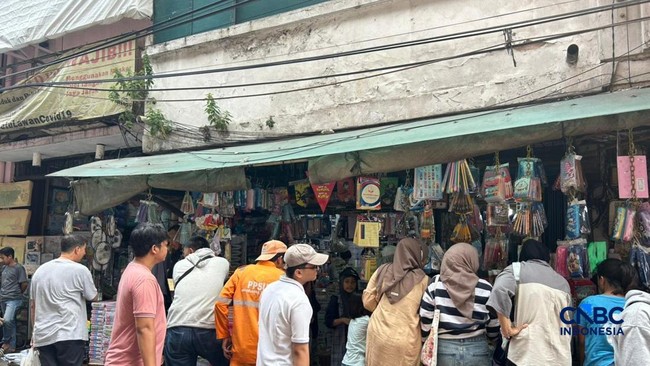
Asemka Morning Market, located in Tambora, West Jakarta, has suddenly become crowded with visitors ahead of the 2026/2027 academic year. It appears that the public has begun searching for stationery and other school supplies.
Based on observations by CNBC Indonesia on Tuesday (30/06/2026), various stationery items ranging from notebooks, pens, markers, and pencils to pencil cases, correction tape, and erasers are being offered in shops. Not only in stationery stores, but seasonal stationery traders are also appearing in large numbers along the Asemka flyover.
Budi, a seasonal stationery trader in the Asemka area, noted that sales have begun to show signs of life over the last two days, although it cannot yet be described as a massive boom. Typically, the number of buyers increases significantly as the new school term approaches.
“Since the Covid-19 pandemic, stationery sales have been declining,” Budi told CNBC Indonesia.
Budi continued, explaining that he sells a pack of SIDU brand notebooks for Rp 45,000 per pack. One pack contains 10 notebooks with 38 pages each. For the BigBoss brand, Budi sells them for Rp 35,000 per pack, consisting of 10 notebooks with 50 pages each.
In addition to notebooks, Budi also offers other stationery such as pens, pencils, coloured pencils, pencil cases, erasers, sharpeners, and crayons.
Moving to another seasonal stall, Nugroho mentioned that his stationery stall often becomes crowded as the school holidays draw to a close. “Usually, it gets busy about a week before school starts. Right now, it is not yet extremely crowded,” he said.
He noted that in recent days, many visitors have been looking for stationery and pens. Typically, a single customer might purchase two packs of notebooks and one pack of pens.
He also mentioned that the stationery products he sells are sourced from shops or agents, claiming that the stock includes both local and imported products.
Regarding pricing, Nugroho prices notebooks at around Rp 30,000 to Rp 40,000 per pack, while pens are priced between Rp 15,000 and Rp 150,000 per pack.
Nugroho added that colouring products, such as crayons and coloured pencils, are mostly sought after by parents of preschool and kindergarten children. Despite the influx of visitors, Nugroho stated he does not intend to raise his prices, fearing it would burden consumers. “I won’t raise the prices; I feel bad for the buyers,” he explained.
On the other hand, Ian, another seasonal trader at Asemka Market, admitted that stationery sales are not yet booming. However, he hopes that products will sell more extensively in the coming period.
Ian said that his stall is currently frequently visited by both stationery resellers and retail consumers. Resellers typically buy products in large quantities or dozens to resell, whereas retail consumers buy around 2 to 5 packs of notebooks for personal or school needs.
“But there are many enthusiasts or those who already know the brands; SIDU is the most popular. Sinar Dunia is the most sought after,” he said.
Furthermore, Ian admitted that he usually sells products that have high seasonal demand. For example, during the New Year holiday period, he sells fireworks, whereas during the school holiday period, he sells stationery.
Additionally, Ian stated that the stationery he sells includes both local and imported products. As an example, a locally made pencil case is sold by Ian for Rp 35,000, whereas an imported product of the same type is naturally more expensive, at approximately Rp 65,000.
Source: jawawa.id (https://jawawa.id/newsitem/asemka-market-suddenly-bustling-ahead-of-new-school-year-1782881494)
Originally published by CNBC Indonesia (https://www.cnbcindonesia.com/news/20260701102952-4-747075/pasar-asemka-tiba-tiba-bangkit-dari-kubur-ada-apa), translated from Indonesian