
Asemka Market Rises from the Grave, Filled with Seasonal Traders and Buyers
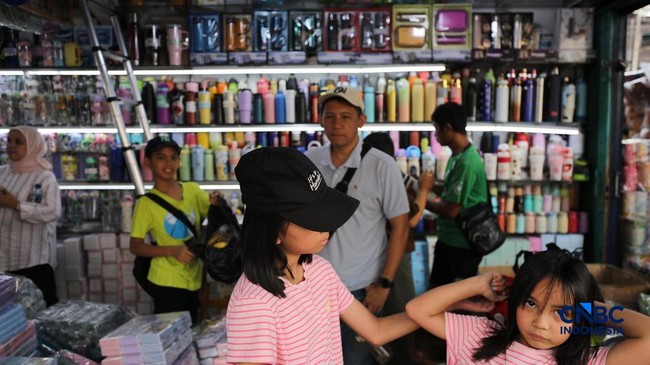
Ahead of the 2026/2027 school year, Pasar Pagi Asemka in Tambora, West Jakarta, has been bustling with residents seeking stationery supplies. Based on observations on Tuesday (30/6/2026), various items such as books, pencils, pens, markers, pencil cases, sharpeners, correction fluid, and erasers were on sale. These goods were not only available in office stationery shops but also along the Asemka flyover underpass, offered by seasonal traders.
One such seasonal trader, Ian, admitted that stationery sales had not yet been particularly strong despite a flow of visitors. Nevertheless, he hoped the products would sell better in the coming days. Ian’s stall is frequented by both resellers, who buy in bulk or by the dozen for resale, and regular consumers purchasing smaller quantities like two to five packs of notebooks for personal or school use. ‘But the one that’s already popular or that people already know is just the SIDU brand. Sinar Dunia is the most popular,’ he said. Ian explained he is accustomed to selling different high-demand products seasonally; for instance, he sells fireworks during the New Year holiday period and stationery during the school holidays. He noted that the stationery he sells includes both locally made and imported products. A locally made pencil case box is priced at Rp 35,000, while the imported equivalent is more expensive at around Rp 65,000.
Another seasonal trader, Roni, reported that stationery sales at his shop have recently declined, with turnover dropping by as much as 50%. He attributed the slump partly to the uncertain economic conditions in Indonesia, acknowledging that all sectors are facing similar pressures. ‘Employees know exactly how much salary they receive each month, so their budget is fixed. For traders, it’s unclear,’ he said. Roni has also tried selling on marketplace platforms, but his online shop has not yielded optimal results. ‘Every single receipt is charged Rp 1,250, not including the admin fee, which is around 20%,’ he explained. According to Roni, to attract many buyers, sellers must participate in promotional programmes. The stationery he offers, including books, pens, and pencil cases, is sourced from agents and includes both locally manufactured and imported goods. His prices vary; for example, Kiky brand notebooks are priced around Rp 38,000, while SIDU brand notebooks are around Rp 45,000.
Loyal customer Junaenah said she always makes time to visit Pasar Asemka during school holidays, having been a long-time patron. She cited the wide variety of stationery and affordable prices as the main reasons. ‘Every holiday, thank God, I make it here to buy school supplies, like covers, books, and all the stationery. The prices are better compared to regular shops,’ she said. The Cengkareng resident noted that while a single notebook might cost Rp 6,000 at a regular stationery shop, she only needs to pay Rp 3,500 at Pasar Asemka, claiming a 50% price difference. Another loyal customer, Deddy, prefers shopping at Asemka because the prices are much cheaper than at bookstores near his home in Teluk Gong, North Jakarta. ‘The price is cheap, indeed cheaper than elsewhere. At my place in Teluk Gong, it’s Rp 55,000 per pack; here it’s Rp 48,000 per pack with 50 sheets,’ he explained. With such a significant price gap, Deddy regularly buys stationery at Asemka, which he then distributes to orphans in need. He confirmed he uses his personal funds, earned from his salary as a driver at a Jakarta-based company.