
ASEAN-SEAMEO Roadmap Officially Launched, Focusing on Enhancing Early Childhood Education Quality in Southeast Asia
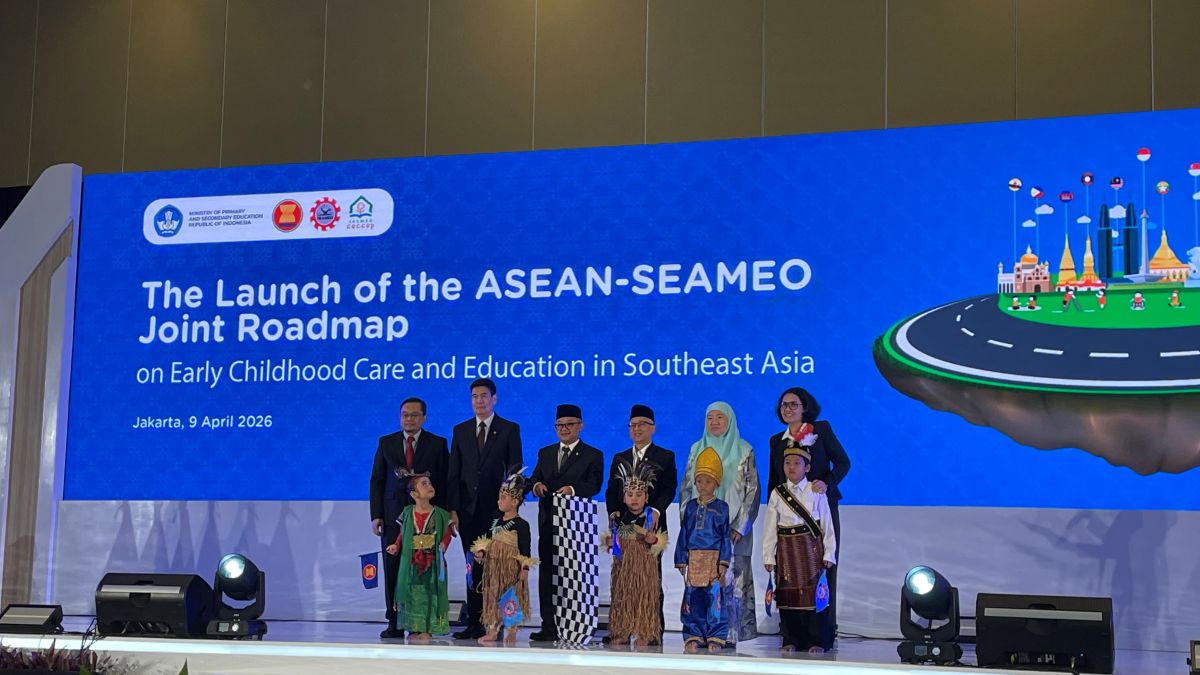
The Ministry of Basic and Secondary Education (Kemendikdasmen) has officially launched the ASEAN-SEAMEO Joint Roadmap on Early Childhood Care and Education (ECCE) on Thursday (9/4). This initiative represents a strategic step to strengthen human resources from the earliest stages through early childhood education and care (PAUD).
The document, jointly initiated by the ASEAN Secretariat and the SEAMEO Secretariat, responds to the varied access and quality of early childhood services in Southeast Asian countries. Differences in fiscal capacity, educator quality, and educational infrastructure pose challenges that require cross-border collaborative solutions.
Minister of Basic and Secondary Education (Mendikdasmen) Abdul Mu’ti emphasised that the ECCE roadmap is a collective commitment by ASEAN countries and partners to strengthen early childhood education services and protection. “ECCE is part of the cooperation programme among ASEAN countries and partner nations to provide services and education for young children. Therefore, this programme demonstrates the Indonesian government’s commitment, particularly regarding educational services and protection for young children,” said Abdul Mu’ti in Jakarta on Thursday (9/4).
He added that the launch of this roadmap aligns with national priority programmes, such as 13-year compulsory education starting from kindergarten, as well as the free nutritious meal programme for pregnant women, breastfeeding mothers, and children in both formal education and preschool.
Meanwhile, the Director General of Early Childhood Education (PAUD) at Kemendikdasmen, Gogot Suharwoto, explained that the launch marks the beginning of joint implementation across all ASEAN member countries. “This launch means we are starting to implement the roadmap jointly between ASEAN and SEAMEO, involving 11 member countries that will participate in carrying it out. This roadmap was actually initiated by Indonesia when it served as chair of the ASEAN-SEAMEO Declaration in 2023 and continued in 2024, led by SEAMEO CECCEP (Centre for Early Childhood Care, Education and Parenting),” stated Gogot.
He explained that SEAMEO CECCEP serves as the driving force for implementing this roadmap, with support from various partners such as UNESCO, UNICEF, the Tanoto Foundation, and networks of academics and practitioners. According to him, the ECCE roadmap contains seven main focuses that must be met in early childhood education services.
“This roadmap includes seven important aspects that must be provided to young children, starting with improving access to services, then learning services, followed by strengthening human resources—teachers, school principals, supervisors, including day care—and partnerships with all partners, especially in Indonesia where 95% of PAUD institutions are private, so partnerships must be involved,” he clarified.
Additionally, the roadmap emphasises the importance of empowering parents in child rearing. “Then there is empowering parents and parenting, because parenting and caregivers must be involved in early childhood education from TPA, KB, and TK,” he continued.
The utilisation of technology is also a key focus. The government, said Gogot, has distributed interactive digital boards to tens of thousands of PAUD institutions across Indonesia. “Equally important is the utilisation of technology; we have already provided interactive digital devices to 64,000 PAUD institutions throughout Indonesia. Hopefully, this year we will add around 120,000 more,” he revealed.
No less important, this roadmap also promotes strengthening funding for early childhood education from various sources. “Then there is also fundraising and funding sources for PAUD. PAUD can now be funded from various sources, both central government, regional, and village levels,” added Gogot.
Furthermore, SEAMEO Director Habibah Abdul Rahim affirmed that the ECCE roadmap is a derivative of the regional declaration that serves as a milestone for the collective commitment of Southeast Asian countries to strengthen early childhood education.
“As has been stated, this roadmap stems from the Declaration of Early Childhood Care and Education in Southeast Asia, which is then translated into a roadmap developed jointly by ASEAN and SEAMEO. Therefore, this roadmap is very important because early childhood education is not just an investment, but the main foundation in shaping children from the early stages of life,” said Habibah.
She added that this roadmap provides a basis for countries in the region to demonstrate their respective commitments, while strengthening cross-sector collaboration. “This joint roadmap provides a foundation for the region to show each commitment to early childhood education. Moreover, this roadmap does not only focus on educational aspects alone but also emphasises the importance of collaboration with various parties. This is because efforts to strengthen early childhood education require cross-sector cooperation and stakeholder involvement,” she stated.
According to her, the foundation of education from an early age will determine future learning success and the quality of human resources in the region. “Thus, this roadmap provides a foundation, as mentioned, for us to jointly build children from an early age. This foundation is very important for the learning process, student success, and for forming individuals who will later become part of the workforce in their respective countries or in the Southeast Asian region,” she concluded.
With the launch of the ECCE roadmap, Indonesia reaffirms its role as the initiator and driving force of collaboration.
Source: jawawa.id (https://jawawa.id/newsitem/asean-seameo-roadmap-officially-launched-focusing-on-enhancing-early-childhood-education-quality-in-southeast-1775739064)
Originally published by Media Indonesia (https://mediaindonesia.com/humaniora/877903/roadmap-asean-seameo-resmi-diluncurkan-fokus-tingkatkan-kualitas-paud-asia-tenggara), translated from Indonesian