
ASEAN Manufacturing Showdown: Indonesia Now Outperforms Vietnam and Malaysia
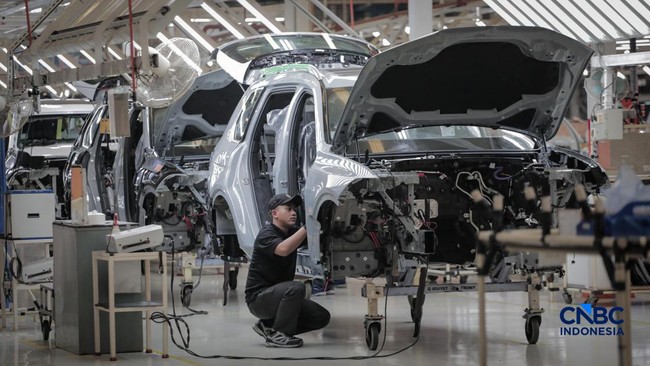
Manufacturing industries in several Southeast Asian countries showed fairly positive growth towards the end of 2026, despite a global economy still under pressure from the Middle East conflict.
Indonesia recorded one of ASEAN’s strongest manufacturing performances, outperforming Vietnam and Malaysia. Thailand, however, remained in the top position.
This is reflected in the Manufacturing Purchasing Managers’ Index (PMI) report released by S&P Global on Monday (2 November 2026), covering October 2026.
Of the five countries compared—Thailand, Indonesia, Vietnam, Malaysia and Myanmar—four recorded manufacturing expansion. Myanmar was the only country still in contraction.
The PMI is an indicator of manufacturing industry conditions based on surveys of companies. A reading above 50 signals expansion, while a figure below 50 indicates contraction compared with the previous month.
Thailand leads as Vietnam and Malaysia compete, while Myanmar lags
Amid ASEAN’s manufacturing competition, Thailand retained its position as the country with the most expansionary industrial activity.
Manufacturing in the “Land of the White Elephant” has now been in expansion for 18 consecutive months.
This was driven by the large volume of new orders received by companies, as demand increased and sales markets widened.
Growth in new orders was among the fastest in the survey’s history, while production activity reached its highest rate since December 2025.
However, increased factory activity has also brought challenges. Some companies are beginning to face labour shortages as employees resign, leaving a growing backlog of unfinished work.
Vietnam, meanwhile, maintained manufacturing expansion for 16 consecutive months, although growth in production and new orders began to slow.
One problem was disruption to raw-material supplies, which made it difficult for companies to increase production. Higher fuel and transport costs added to the pressure, while export demand continued to decline.
These conditions also affected employment, which fell for the third consecutive month.
Unlike Vietnam, Malaysia began to show signs of recovery after its manufacturing activity contracted in September.
One driver was increased demand for products related to artificial intelligence (AI).
That demand helped companies secure more new orders and raise production again. Order growth was among the fastest in about four and a half years.
Nevertheless, high transport and raw-material costs, as well as delivery delays, remain challenges for Malaysian businesses.
Myanmar, by contrast, had the weakest manufacturing conditions in this comparison.
While the other four countries were in expansion, Myanmar’s factory activity continued to shrink.
Weak demand, limited raw materials, rising production costs and tighter import rules made it difficult for companies to maintain production.
The contrasting conditions show that although manufacturing activity is beginning to improve in most ASEAN countries, the recovery is uneven.
Indonesia surges as export orders hit a record
Against this backdrop, Indonesia was among the countries recording the most striking improvement.
Domestic manufacturing activity rose sharply, with the PMI posting the biggest increase among the four other ASEAN countries in the comparison.
Factories received more orders from both domestic and overseas markets. Companies responded by increasing production to meet customer needs.
According to S&P Global, Indonesia’s manufacturing PMI rose to 54.0 in October from 52.4 in September.
This was the highest reading since March 2024, or in the past 31 months.
Notably, the improvement was not driven solely by increased production activity.
New orders received by manufacturing companies grew at their fastest rate in about five years. Export-order growth reached a record high since S&P Global’s survey began in April 2011.
This shows that international demand for Indonesian manufactured goods is rising strongly.
To meet that demand, companies increased their purchases of raw materials and drew on stocks of finished goods already available.
As a result, inventories of finished goods fell at their sharpest rate since August 2020.
Even so, one issue still warrants attention.
The rise in production activity has not been matched by substantial job creation. Companies continued to recruit, but employment growth was very limited.
Meanwhile, unfinished work continued to accumulate as more orders came in.
S&P Global Market Intelligence economist Usamah Bhatti said the increase in demand was a positive signal for industrial activity in the coming months. However, employment trends still needed to be monitored.
Another concern is rising production costs, particularly those driven by fuel and raw-material prices and unfavourable exchange-rate movements.
These pressures have begun to prompt companies to raise the prices of their products. Although Indonesia’s manufacturing industry is performing strongly, the next challenge is to sustain the increase in orders while creating more jobs.
Source: jawawa.id (https://jawawa.id/newsitem/asean-manufacturing-showdown-indonesia-now-outperforms-vietnam-and-malaysia-1793613109)
Originally published by CNBC Indonesia (https://www.cnbcindonesia.com/research/20261102133310-128-781538/adu-kuat-manufaktur-asean-ri-kini-kalahkan-vietnam-malaysia), translated from Indonesian