
ASEAN Journalists Trained on Mass Atrocities in Migration Context
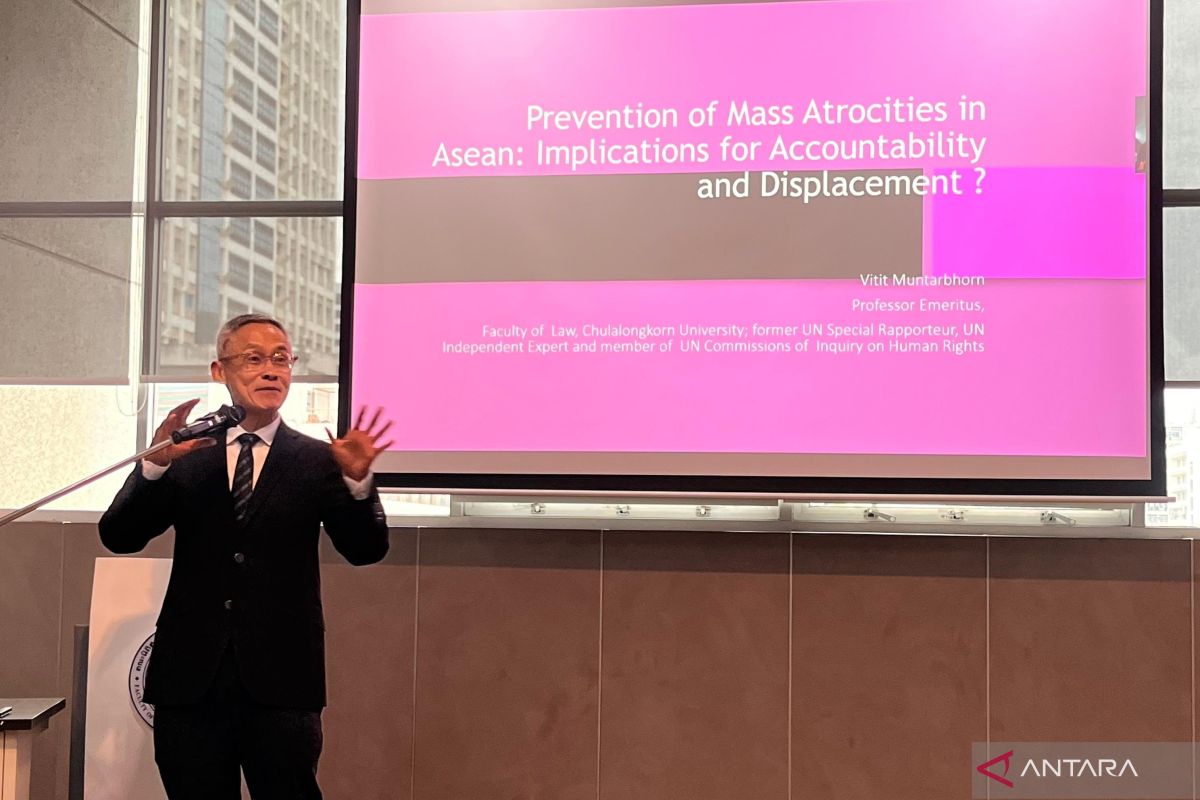
Bangkok, Thailand (ANTARA) - A total of 25 journalists and media communication professionals participated in a training programme titled “Prevention of Mass Atrocities in the Context of Migration in ASEAN” in Bangkok, held from 6-8 July 2026.
The event, facilitated by the Faculty of Law at Chulalongkorn University, was funded by the Auschwitz Institute for the Prevention of Genocide and Mass Atrocities (AIPG).
“The reason we are training various professions, which in this instance are journalists, is so that they can understand genocide, mass atrocities, and the current conditions in 2026 within each respective country,” said Ana Maria Rodriguez, coordinator of the Bruno and Suzanne Scheidt AIPG Global Refugee Protection Programme, on Wednesday.
“Furthermore, the journalists who have received this capacity building will form projects that can be implemented in the field. This allows us to measure whether they can create an impact,” Ana added.
Journalists were given the opportunity to delve into various journalistic aspects of reporting on migration and refugee issues, prioritising humanitarian perspectives and avoiding hate narratives.
A number of academics and practitioners led the training sessions, including Dr Vitit Muntarbhorn from Chula Law Faculty, who explained the legal frameworks regarding mass atrocities.
Additionally, Nicha Wachpanich and Nathapob Sungkate, two journalists from HaRDstories, highlighted the role of responsible journalism in countering misleading information regarding refugees that is prevalent on social media.
According to Ana, migration was chosen as the context because it represents the primary point where groups become vulnerable to mass atrocities or other human rights violations.
Telly Nathalia, a participant from Indonesia, stated that despite frequently covering migration issues in her journalistic writing and advocacy work, she learned a great deal through this training.
“It turns out the issue of migration is very broad, not just about asylum seekers or refugees due to disasters. There are many segments of migration. As journalists, the most important principle is ‘do no harm’,” said the journalist, commonly known as Lia.
The ‘do no harm’ principle, as understood by Lia, involves ensuring that reporting continues to humanise vulnerable groups.
She noted that even when facing tight deadlines, journalists should rather delay slightly than rush to report something that could have a negative impact on sources from vulnerable groups.
Another participant from Thailand, Fiza Awan, shared a similar view. As a recent journalism graduate from Chula who has interned at media companies, she emphasised that narratives can inadvertently endanger others.
“The narratives we present can sometimes, without us realising, have dangerous framing. Therefore, even when working under tight time constraints, journalists must remain cautious in writing and publishing news,” said Fiza.
Furthermore, Fiza noted that the training, which brought together participants from various ASEAN nations, is vital for building networks and gaining deeper insights into the situations and conditions occurring in neighbouring countries.