
ASEAN-China Week 2026 Opens, Strengthening Economic Cooperation and AI
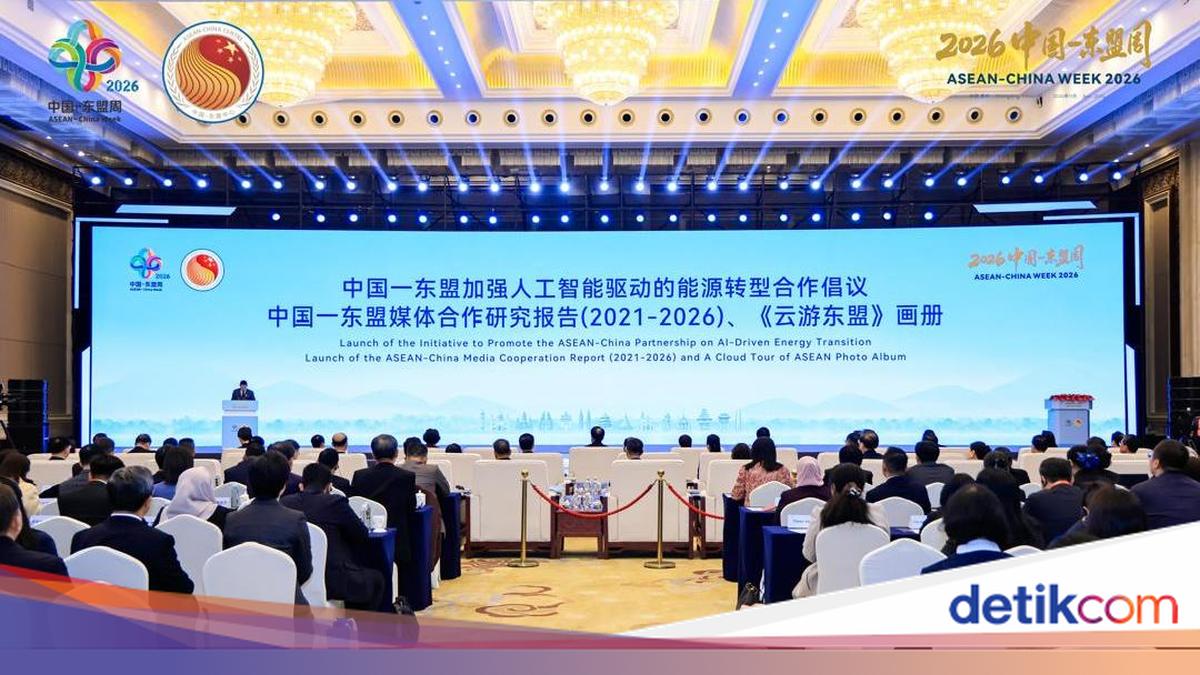
ASEAN-China Week 2026 has officially opened in Chongqing, China. The event is an opportunity to strengthen cooperation between Southeast Asian countries and China across sectors ranging from the economy to artificial intelligence (AI) technology.
Detikcom attended the opening ceremony at Jinxiu Hall, Yuzhou Hotel, Chongqing, on Monday (23 November 2026). Nearly 300 government officials, diplomats and delegates from China and ASEAN member states took part.
The event also marks 35 years of ASEAN-China dialogue relations, five years of the Comprehensive Strategic Partnership (CSP), and the 15th anniversary of the ASEAN-China Centre (ACC).
ACC Secretary-General Zhang Lizhong said the partnership between the two regions had become one of the Asia-Pacific’s most dynamic models of regional cooperation. He said two-way trade exceeded US$1 trillion last year and grew by 29.6 per cent in the first ten months of 2026. He also noted that 2027 had been designated the ASEAN-China Year of AI Cooperation.
“ASEAN and China have followed a bright path of good-neighbourly relations and mutually beneficial cooperation, setting an example as the Asia-Pacific’s most successful and dynamic regional partnership, while providing sustained momentum for peace, stability, development and prosperity in the region,” Zhang said at the opening.
ASEAN Deputy Secretary-General for the ASEAN Political-Security Community, Dato’ Astanah Abdul Aziz, echoed his remarks. Representing ASEAN Secretary-General Kao Kim Hourn, she said economic integration between the two regions was increasingly visible in people’s daily lives.
“From Jakarta to Bangkok, BYD electric vehicles, Mixue outlets and Pop Mart collections have become familiar sights, while Vietnamese coffee and Malaysia’s Musang King durians are increasingly entering households in China. These exchanges show how closely interconnected our economies are,” Astanah said.
Thailand’s First Deputy Speaker of the House of Representatives, Mallika Jiraphanwanich, stressed the importance of deepening strategic trust through parliamentary diplomacy to address cross-border challenges. She pointed to the uncertainty facing the world.
“The world is currently facing geopolitical uncertainty, economic challenges, climate change and various new transnational threats. These challenges remind us that no country can face them alone,” Mallika said.
Chongqing cooperation plan and new initiatives
Chongqing, the host city, is a key hub for the New International Land-Sea Trade Corridor (ILSTC), which now reaches 602 ports in 128 countries and regions. Trade between Chongqing Municipality and ASEAN totalled RMB127.2 billion from January to October 2026, up 16.7 per cent.
Several initiatives were formally announced during the outcomes launch:
Ten Chongqing-ASEAN cooperation plans for the next five years. The plans target annual trade of more than RMB150 billion and 50 investment projects in ASEAN, as well as training 350 science and technology professionals and promoting cross-border computing cooperation. Chongqing also aims to open more than 20 passenger and cargo air routes, welcome more than 5,000 ASEAN students each year and facilitate exchanges involving more than five million tourists. Other areas include smart agriculture, AI legal research, healthcare, media and youth cooperation.
The ASEAN-China Initiative on AI-Based Energy Transition Cooperation. Launched jointly by the ACC, CPIIS and CC BRITTC, the initiative aims to accelerate the use of AI in the green energy transition.
Eleven flagship cross-border tourism routes. The routes connect Europe and the Americas, Sichuan-Chongqing, and ASEAN through the Two-Way Million-Visitor Initiative.
Two joint publications. These are the ASEAN-China Media Cooperation Report (2021-2026), produced by the ACC and CICG, and a photo album entitled A Cloud Tour of ASEAN.
Dialogue on the AI ecosystem
The programme continued on Monday with a dialogue entitled “Exploring New Horizons in Economic Cooperation: AI-Based Digital and Green Transformation”. Philippine Undersecretary of Trade and Industry Ceferino Rodolfo said that developing future technologies such as AI could not be done by countries acting alone.
“AI is often discussed merely as software, but behind every AI model is a real physical economy. AI requires semiconductors; semiconductors require critical minerals; data centres require energy; and innovation requires talent. No single country has all these capabilities. That is why AI is not a national project, but an ecosystem project,” Rodolfo said.
Thailand’s Deputy Permanent Secretary for Commerce, Wittayakorn Maneenetr, highlighted the strategic role of the Protocol to Upgrade the ASEAN-China Free Trade Area 3.0 (ACFTA 3.0), which is due to take effect on 1 December 2026.
“Given a rapidly changing and uncertain global economic landscape, we cannot rely solely on past successes. ACFTA 3.0 expands our collaboration well beyond traditional tariff reductions, establishing a modern framework for supply-chain connectivity, the digital economy and the green economy,” Wittayakorn said.
Brunei Darussalam’s Permanent Secretary at the Ministry of Foreign Affairs, Johariah Wahab, expressed a similar view. She said Chongqing had a key role in opening market access between China’s inland regions and ASEAN.
“Amid global economic uncertainty and shifting supply chains, closer cooperation and sustainable development are more crucial than ever. As ASEAN pursues its Community Vision 2045 and China advances its modernisation, this week can help turn our shared aspirations into real opportunities,” Johariah said.
Asia-Pacific Space Cooperation Organization (APSCO) Secretary-General Jiang Hui said more than 220,000 images from seven Chinese satellites, along with Fengyun ground stations, would be made openly accessible to strengthen disaster and climate early-warning systems in Southeast Asia.
“Outer space is a shared domain belonging to humanity. Our cooperation rejects monopolies on the privileges of space and opens the way for countries, large and small, to build independent space capabilities, address climate impacts, develop local industries and explore space together,” Jiang said.
Source: jawawa.id (https://jawawa.id/newsitem/asean-china-week-2026-opens-strengthening-economic-cooperation-and-ai-1795477973)
Originally published by detikcom (https://news.detik.com/berita/d-8766788/asean-china-week-2026-resmi-dibuka-perkuat-kerja-sama-ekonomi-hingga-ai), translated from Indonesian