
ASEAN Agrees to Accelerate Control of Invasive Species through AIM-ASEAN
Our islands are not only bastions of biodiversity but also highly vulnerable to the entry and proliferation of invasive species.
Jakarta (ANTARA) - The Ministry of Forestry (Kemenhut) and the ASEAN Centre for Biodiversity (ACB), together with the ASEAN Secretariat and representatives from Brunei Darussalam, Cambodia, Myanmar, Thailand, and Timor-Leste, have agreed to form a strategic regional project for controlling Invasive Alien Species (IAS).
Director General of Natural Resources and Ecosystem Conservation at Kemenhut, Satyawan Pudyatmoko, stated in a press release received in Jakarta on Thursday that invasive species have become a major factor in 60 per cent of recorded global extinctions.
“For archipelagic countries like Indonesia and other ASEAN nations, this threat is even greater. Our islands are not only bastions of biodiversity but also highly vulnerable to the entry and development of invasive species,” said Satyawan.
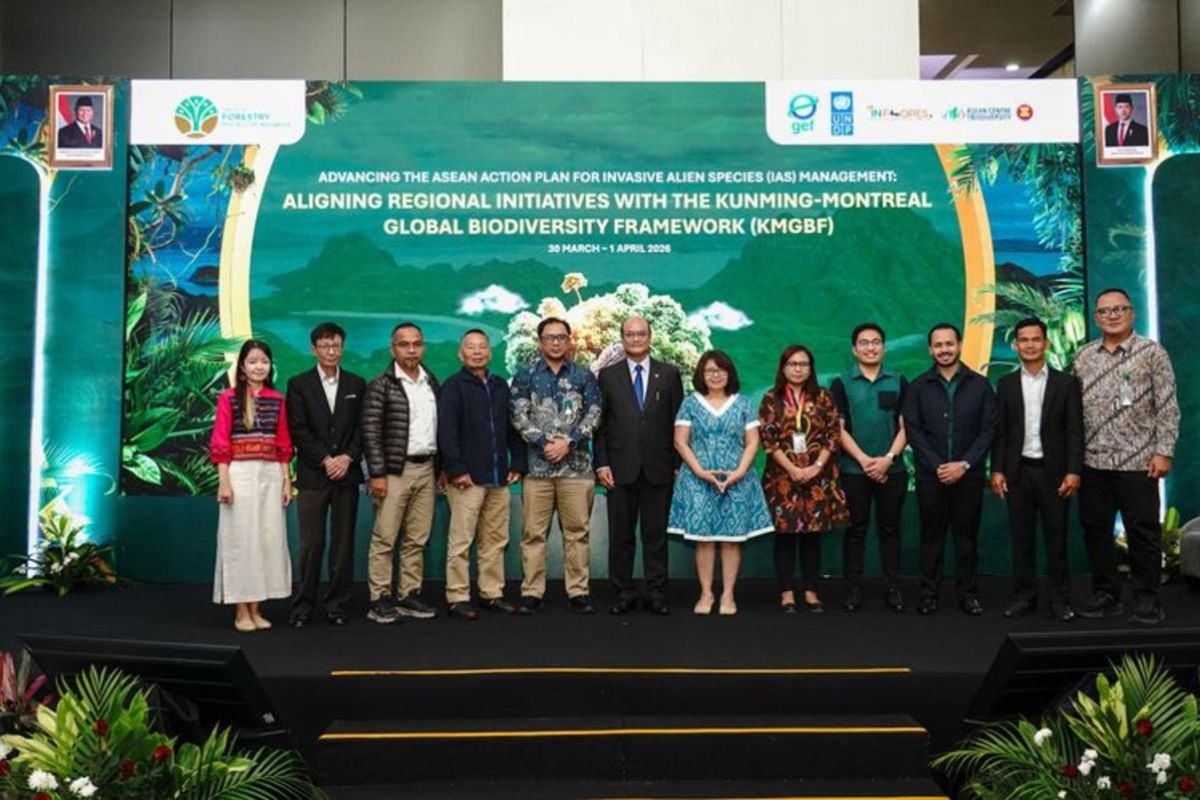
The agreement was reached during the workshop “Advancing the ASEAN Action Plan for Invasive Alien Species (IAS) Management: Aligning Regional Initiatives with the Kunming-Montreal Global Biodiversity Framework (KMGBF)”, held from 30 March to 1 April 2026 in Jakarta.
The project will serve as a tangible manifestation of ASEAN’s contribution to achieving Target 6 of the Kunming-Montreal Global Biodiversity Framework (KMGBF), which is to reduce by at least 50 per cent the rate of introduction and spread of priority invasive species by 2030.
He specifically highlighted that ASEAN’s regional connectivity through trade, transportation, and tourism has become the main entry route for invasive species. However, handling that has so far been national and sectoral in nature has not been able to address cross-border threats.
In the forum, six main components of the AIM-ASEAN project were then formulated, including the establishment of the ASEAN IAS Task Force, designation of national focal points, and policy harmonisation dialogue.
In addition, regional training in taxonomy, risk assessment, EDRR (Early Detection, Rapid Response), and integrated pest management was discussed, as well as facilitating knowledge exchange and implementation of integrated biosecurity and EDRR approaches at potential sites, including Komodo National Park as one of the important references for developing scalable control models to other protected areas.
Mechanisms for financing, preparation of the ASEAN IAS financing strategy, and mobilisation of funding sources from public, private, and international partners were also discussed.
“We must not leave the room just with ideas, but with a blueprint for real action,” he said.
“The AIM-ASEAN project is proof of our commitment to protecting ASEAN’s natural heritage for future generations,” Satyawan Pudyatmoko concluded.