
Asbanda: We Are Not Asking for Protection, Regional Development Banks Need a Fair and Equal Business Ecosystem
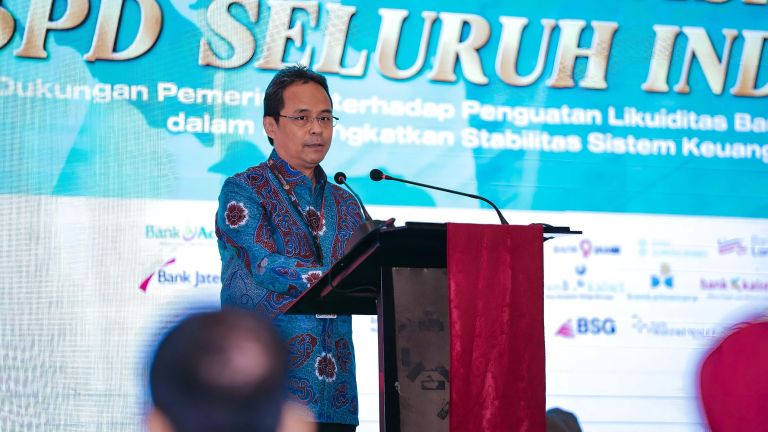
The Association of Regional Development Banks (Asbanda) is pushing for the creation of a fair and equal business ecosystem (level playing field) for Regional Development Banks (BPD) in various government programmes and transactions. Asbanda also emphasised strengthening the role of BPDs as Regional Development Banks, which serve as one of the pillars of regional economic development and the stability of the national financial system.
Asbanda Chairman Agus Haryoto Widodo asserted that BPDs are not asking for protection from competition. As long as they meet technology, governance, service and risk management standards, BPDs need to obtain equal opportunities to become disbursement banks and government partners.
“We are not asking for protection. We are asking for a level playing field. BPDs must be ready to compete through service quality, digital capability and governance,” said Agus at the seminar “Government Support for Strengthening BPD Liquidity in Enhancing National Financial System Stability” in Bengkulu on Friday (21/8/2026).
As of June 2026, the total assets of 27 BPDs reached approximately Rp1,043 trillion, with loans of around Rp673 trillion and third-party funds of around Rp770 trillion.
According to Agus, the fundamental condition of BPDs is healthy. However, the intermediation function that continues to grow amid pressure on funding sources needs to be monitored so that it does not increase the cost of funds and ultimately limit the ability of BPDs to provide competitive financing.
“BPD liquidity is not merely a matter of the bank’s balance sheet. BPD liquidity is part of regional development capacity,” Agus stressed.
This is because BPDs play an important role in financing various regional economic needs, from MSMEs, food, housing, health, education, transport to infrastructure.
Asbanda also considers that the liquidity structure of BPDs has its own characteristics because it is closely linked to the regional fiscal cycle, transfers to regions, regional budgets (APBD) and various transactions within the regional government ecosystem. Therefore, changes in fiscal design and government fund disbursement mechanisms need to consider their impact on the resilience of the regional financial ecosystem.
“Policy efficiency remains important. However, we also need to maintain a balance between central efficiency and regional financial resilience so that economic activity and liquidity can continue to provide optimal multipliers for the regions,” said Agus.
Asbanda is urging that government fund placement policies at BPDs be increasingly directed towards strengthening productive sector intermediation. Such placements can be linked to financing priority sectors such as MSMEs, food, housing, health, education and regional infrastructure.
“Government funds should not stop at being liquidity. We need to encourage them to become multipliers for regional economic growth,” said Agus.
In addition, Asbanda is pushing for a regional development impact perspective in the formulation of various national policies, given that BPDs have characteristics and functions that differ from commercial banks in general.
BPDs do not only carry out intermediation functions, but are also part of managing the regional financial ecosystem, expanding financial inclusion and financing regional development.
Agus stressed that strengthening BPDs is not only the agenda of the government and regulators. Asbanda and all BPDs also have homework to improve competitiveness through strengthening collaboration among BPDs in liquidity management, money markets, repos, treasury and financing syndication. At the same time, BPDs must accelerate digital transformation, strengthen cybersecurity, governance and risk management, and increase current account savings accounts (CASA) from the public and the business world.
“We do not want BPDs to be protected from competition. We want BPDs to be strengthened so that they are able to compete,” Agus asserted.
With assets of more than Rp1,000 trillion and a presence rooted across all regions of Indonesia, Asbanda is encouraging BPDs to move up a class to become Regional Development Banks that are increasingly healthy, digital and competitive.
“A strong national financial system cannot possibly be built only from the centre. It requires strong roots in all regions, and BPDs are one of those roots. When BPDs become stronger, the beneficiaries are not only the BPDs, but the regions and ultimately Indonesia,” Agus concluded.