
As War De-escalates, Japan, China and The Fed Still Make Indonesia Jittery
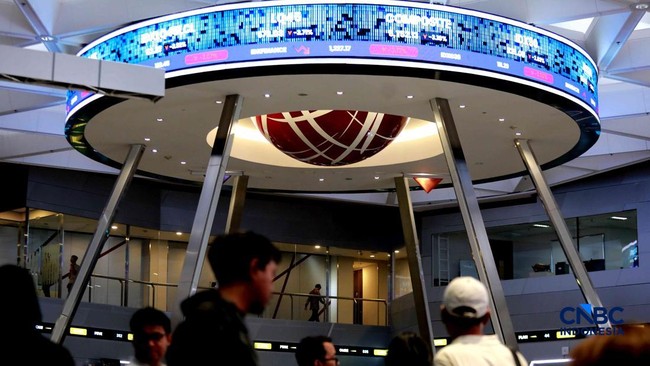
Indonesian financial markets are expected to continue their strengthening today and throughout this week amid a slew of important announcements. Nevertheless, market participants remain cautious. US President Donald Trump told the New York Times on Sunday that if Iran fails to reach a final nuclear deal with the US, Washington could resume military strikes on Tehran or act as the “guardian of the Middle East” in exchange for 20% of the region’s revenue.
On Wall Street, US stock markets moved mixed on Tuesday’s trading session, or early Wednesday Indonesian time. The Dow Jones Industrial Average hit a record as investors rotated out of chipmaker stocks into cyclical shares amid falling oil prices. The Dow rose 328.64 points, or 0.64%, to close at a record high of 51,999.67. During the session, the Dow even touched an all-time peak of 52,190.29. In contrast, the S&P 500 fell 0.57% to close at 7,511.35, while the Nasdaq Composite weakened 1.15% to 26,376.34. The tech-heavy Nasdaq’s decline was triggered by weakness in several chip stocks. Advanced Micro Devices (AMD) slumped more than 7%, Broadcom fell 4%, Micron Technology weakened 6%, and Nvidia lost over 2%.
On the other hand, oil prices extended their decline from the previous session. Brent futures dropped 5.06% to settle at US$78.96 per barrel, while US West Texas Intermediate (WTI) tumbled 5.82% to US$76.05 per barrel. This marked the first close below US$80 per barrel for both contracts since early March. As oil prices fell, industrial and banking sector stocks strengthened. Caterpillar led gains in industrial stocks with a surge of more than 1%, while JPMorgan Chase rose over 3%. Investors are betting that lower energy prices will spur a re-acceleration of US economic growth.
SpaceX returned to the spotlight after soaring nearly 5%, continuing a sharp rally since its stock market debut last week. Thanks to the increase, SpaceX’s market capitalisation briefly surpassed Microsoft and Amazon during the trading session. The company priced its initial public offering (IPO) at US$135 per share and closed at US$201.80 per share. The performance of the main indices continued the strengthening seen on Monday, after President Donald Trump announced that the United States and Iran had reached an agreement to end the war in the Middle East. Pakistani Prime Minister Shehbaz Sharif said both parties had declared a cessation of military operations on all fronts, with the official signing of the agreement scheduled for this Friday in Switzerland. Trump also said the Strait of Hormuz would be reopened for shipping on Friday, which pushed oil prices down nearly 5% on Monday.
“We are not completely out of the woods yet,” said Andy Goldberg, Chief Investment Strategist at Nomura Asset Management International, as quoted by CNBC International. According to Goldberg, if oil prices fall quickly, headline inflation will also ease. However, on the other hand, lower energy costs will increase US consumer purchasing power. “If oil prices fall fast, headline inflation numbers will come down. But at the same time, more money will go back into consumers’ pockets when they are feeling fairly optimistic, and that condition could actually trigger further inflation,” he said. He added that Federal Reserve Chair Kevin Warsh now faces a difficult task in balancing economic growth and inflation control.
Financial market movements mid-week continue to digest a series of essential economic data releases from both domestic and global spheres. Amid geopolitical uncertainty in the Middle East that has lifted energy prices and created supply chain volatility, investors now hold a number of key macroeconomic indicators.
Development of the War: The United States and Iran reached a temporary 60-day agreement to end the war in the Middle East. Under the deal, the US will lift its blockade of Iranian ports and allow Tehran to resume selling oil, while Iran will reopen shipping lanes in the Strait of Hormuz. President Donald Trump stressed that Iran will not have nuclear weapons, although the issues of ballistic missile programmes and Iran’s support for regional armed groups are not yet on the negotiation agenda. This agreement has the potential to provide significant economic benefits to Iran through sanctions relief and the unfreezing of assets. However, Israel’s position, not being directly involved in the negotiations, creates uncertainty over the sustainability of the ceasefire. Responding to the news, global oil prices fell again to a three-month low as markets anticipate a renewed increase in Iranian oil supply.
Indonesia’s External Debt Grows Amid Record Yuan Denomination: On Monday (15/6/2026), Bank Indonesia released the External Debt Statistics for April 2026, which were recorded at US$439.7 billion. This position shows annual growth of 1.9%, moving higher compared to the growth in March which stood at 1.0%. This growth was mainly supported by public sector external debt, with government debt recording US$216.4 billion, or growing 3.7% year-on-year. The increase in the public sector contrasts with private sector external debt, which continued its contraction phase of 0.7% to US$193.2 billion. Stability in government securities, which recorded net capital inflows, also reflected this trend.
Source: jawawa.id (https://jawawa.id/newsitem/as-war-de-escalates-japan-china-and-the-fed-still-make-indonesia-jittery-1781653851)
Originally published by CNBC Indonesia (https://www.cnbcindonesia.com/research/20260616192020-128-743178/perang-mereda-jepang-china-the-fed-malah-bikin-ri-ketar-ketir), translated from Indonesian